
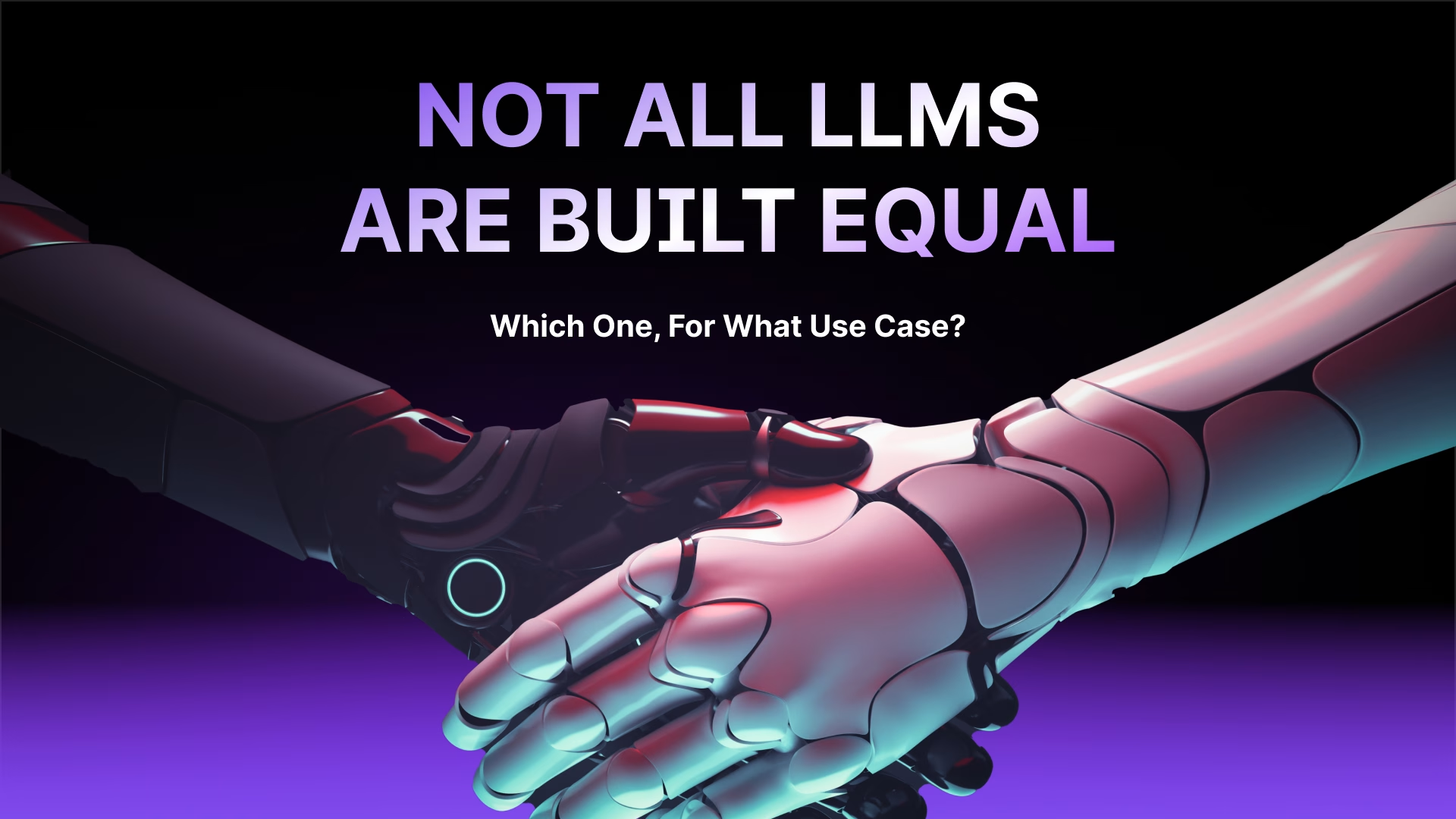



In 2025, the AI landscape has evolved dramatically, with the Large Language Model (LLM) market reaching $8 billion and projected to hit $82.1 billion by 2033. For developers and organisations working on AI integration and development, the question is not whether to use AI; it is about choosing the right model for the right job. If you are a developer or a product owner, it is less about IF and more about WHICH and HOW MUCH today.
With 78% of companies now using AI in at least one function (up from 55% in 2023), understanding the strengths and weaknesses of different LLMs (and trust us, there are so many options to choose from – it’s insane!) has become crucial for making informed decisions. This comprehensive guide breaks down the top models from major providers to help you navigate the complex landscape of AI integration and development.
The Current LLM Landscape
The AI ecosystem in 2025 is dominated by two primary categories: commercial leaders and open-source innovators. Each serves different needs in the AI development and integration pipeline.
What large language models are
Large language models (LLMs) are the engine behind modern AI: large neural networks trained on massive amounts of text (and often code, images or audio) that generate and reason with language. They power the commercial and open‑source foundational models you see in products today, enable multimodal capabilities (text, voice, vision) and support very long context windows measured in tokens. They do astonishing pattern‑matching and synthesis, but they don’t “remember” like a person — their outputs are driven by learned probabilities and the context you give them, which is why choosing the right model and context size matters for real applications.
Commercial Leaders
OpenAI’s GPT-4o: The multimodal powerhouse that handles text, voice, vision and audio natively. With 88.7% MMLU benchmark performance and ~0.32s latency, it’s 9× faster than GPT-3.5 while being significantly more cost-effective at $2.50 per million tokens input (compared to GPT-4’s $75).
OpenAI’s GPT-o1: The o1 series of models are designed for tasks that require reasoning efforts. Since reasoning models output reasoning tokens, those tokens can be analysed to improve the prompt itself, while also ensuring the model performs better across thinking domains – writing, coding, and other complex problems in math & science.
 Top article todayExcel-to-App Evolution: Why the Transformation Matters for SME’s
OpenAI’s GPT-o3, o4-mini and o3-Pro: o3 and o4 series are the SOTA models from OpenAI, that excel in reasoning, self-calculate the amount of reasoning required, and also can choose the right set of tools required to perform these actions (including, but not limited to Python, search for grounding, structured output, and more). o3-Pro is the frontier model that performs complex set of actions really well, in one go.
Anthropic’s Claude 4 Series: Built on Constitutional AI principles, Claude Opus 4 and Sonnet 4 excel in safety, reasoning, and long-context processing. With 200K token context windows and enhanced coding capabilities, they’re ideal for enterprise applications requiring reliability and ethical AI alignment.
Google’s Gemini 2.5 Pro: Google’s first native multimodal model, trained on text, code, images, audio, and video. With 90%+ MMLU performance and up to 1 million token context (expanding to 2 million), it’s particularly strong in scientific and mathematical reasoning. The Gemini family with 1 million context token, is very strong at tasks that require long chain of context management. 2.5 Flash and 2.5 Flash Nano are the cheaper models, with 2.5 Flash being the best balance between features (multimodality) and price.
Grok 4: Grok 4, xAI’s latest offering, with 256k-token window on the API, is a big leap forward from Grok 3 for xAI. On paper, Grok 4 is probably the best model in the world right now. However, due to an excessive focus on benchmarks, it struggles to hit the mark on real-world workflows. Grok was also on a bit of hot water due to it’s latest antisemetic outburst caused by a bad prompt. In addition, evidences showing Grok consulting xAI and Elon Musk’s opinions when asked to make an impartial thought has raised eyebrows for the usage of this model family in production use cases.
Open-Source Champions
DeepSeek R1: The reasoning specialist that uses reinforcement learning for complex problem-solving. With 671B parameters (37B active via MoE architecture), it’s 30× more cost-effective than OpenAI’s o1 model while being 5× faster.
Mistral Family: From Mixtral’s Mixture-of-Experts architecture to Magistral’s symbolic logic focus, Mistral models offer speed and efficiency for edge and compliance-heavy applications. However, Mistral’s licensing restrictions make it tricky to use across a wide use cases, with not many providers offering Mistral as a service.
Meta’s LLaMA 3: Supporting 128K-token context with multilingual capabilities, it powers Meta’s social media platforms while remaining open-source under Apache 2.0 license. While Llama 4 Maverick and Scout were a bit of a disappointment from Meta, the open-source community has shown a lot of love to LLaMA 3, with countless more models being distilled from LLaMA 3 for specific, niche use cases.
Kimi K2: Kimi K2 is a state-of-the-art (SOTA) mixture-of-experts (MoE) language model with 32 billion activated parameters and 1 trillion total parameters. Trained with the Muon optimiser, Kimi K2 achieves exceptional performance across frontier knowledge, reasoning and coding tasks while being optimised for agentic capabilities. This is probably the best model today for any agentic workflows that involves complex chain of tool calls (hands down!), while only being slightly behind Claude’s Sonnet 4 family in coding.
 Read alsoStrait of Hormuz Chokehold Warning Lessons for Australian Businesses!
If you’re weighing an assistant that lives inside Microsoft 365 against a broad conversational AI, compare the real strengths and integration differences on Microsoft Copilot vs ChatGPT to see which aligns best with your organisation’s workflow, data access and collaboration needs.
If your projects need open-source models optimised for agentic workflows, explore the GLM 4.5 model family to compare the flagship and efficient variants, their hybrid “thinking” and “non‑thinking” modes, and how Z.ai positions them for complex reasoning.
If you plan to deploy an open-source model for agentic workflows, review empirical comparisons of how models invoke external tools. The study measures function-calling accuracy, consistency and the silent-skip failure mode across 13 models — a practical complement to the open-source champions discussion in Tool-Call Reliability.
AI Integration Use Cases: Which Model for What?
A natural next step is to match the models we've compared to specific marketing responsibilities — from creative content and ad copy to analytics and campaign automation. For a practical, role-by-role mapping and model recommendations, consult Marketing Powered by AI: The Best AI Models for Every Role in 2025.
1. Code Generation and Development
Top Performers:
Get the best ones in your inbox — no spam, unsubscribe any time.
- Claude 3.5 Sonnet: 62.3% on agentic coding tasks, excels at multi-file projects
- OpenAI Codex: 89% resolution rate on Python TypeErrors, integrated with GitHub
- DeepSeek Coder V2: 90.2% on HumanEval, supports 338 programming languages
Best For: Full-stack development, code refactoring, debugging, and IDE integration
Cost Considerations:
- Claude: $3.00 input/$15.00 output per million tokens
- DeepSeek: $0.14 input/$0.28 output per million tokens
- Codex: $1.50 input/$6.00 output per million tokens
2. Conversational AI and Chatbots
Top Performers:
- GPT-4o: Superior multimodal conversational abilities
- Claude 4 Sonnet: Constitutional AI ensures safe, helpful responses
- Gemini 2.5 Pro: Strong multilingual performance (89.8% on Global MMLU)
Best For: Customer service, virtual assistants, educational chatbots
3. Document Processing and RAG Applications
Top Performers:
- Claude 4 Opus: 200K token context for complex document analysis
- Command R+: Optimised for retrieval-augmented generation
- Gemini 2.5 Pro: Up to 1M token context for massive documents
Best For: Legal document review, research assistance, knowledge mining
4. Real-Time Applications
Top Performers:
 Read alsoWhy Most Australian SMEs Use Only 20% of What They Are Paying For Zoho CRM
- Mistral Small 3: 150 tokens/second, 3× faster than LLaMA 3.3
- Qwen 2.5: Low-latency, high-efficiency for real-time tasks
- Gemini 2.0 Flash: 2× speed of Gemini 1.5 Pro
Best For: Live chat systems, real-time data processing, edge computing
5. Specialised Domain Applications
Scientific Computing:
- Gemini 2.5 Pro: 84.0% on GPQA diamond, 86.7% on AIME 2025
- DeepSeek R1: Excels in mathematical problem-solving
Creative Content:
- GPT-4o: Multimodal creativity with voice and vision
- Claude 4 Sonnet: Strong in creative writing and storytelling
Enterprise Integration:
- Claude 4 Opus: Constitutional AI for compliance-heavy sectors
- Cohere Command: Hybrid licensing for enterprise flexibility
Cost-Performance Analysis
Budget-Conscious Options:
- DeepSeek Models: Extremely cost-effective, especially for reasoning tasks
- Open-Source LLaMA 3: Free deployment, customisable
- Mistral Small: Efficient for real-time applications
Premium Performance:
- GPT-4o: Balanced performance across all tasks
- Claude 4 Opus: Premium reasoning and safety features
- Gemini 2.5 Pro: Scientific and mathematical excellence
Enterprise Solutions:
- AWS Bedrock: Multiple models including Claude and Titan
- Google Vertex AI: Integrated Gemini models
- Azure OpenAI: Enterprise-grade GPT models
Making the Right Choice
For Startups and Small Teams:
- Start with DeepSeek or LLaMA 3 for cost-effectiveness
- Use Claude 4 Sonnet for coding-heavy applications, 3.5 Sonnet for slightly cheaper workflows,
- Consider Mistral for real-time requirements, however be careful you do not violate Mistral’s commercial license terms.
For Enterprise Applications:
- Claude 4 Opus for compliance and safety-critical applications
- GPT-o3 for comprehensive multimodal capabilities
- Gemini 2.5 Pro for scientific and research applications
For Specialised Use Cases:
- Coding: Claude 4 Sonnet or DeepSeek V3
- Scientific Computing: Gemini 2.5 Pro
- Real-time Processing: Mistral Small 3
- Long Documents: Claude 4 Opus or Gemini 2.5 Pro
Future Considerations
The LLM landscape is rapidly evolving, with key trends to watch:
- Model Convergence: Performance gaps between open-source and commercial models are narrowing
- Specialised Models: Domain-specific LLMs are emerging for niche applications
- Cost Optimisation: Mixture-of-Experts architectures are reducing inference costs
- Multimodal Integration: Native multimodal capabilities are becoming standard
Conclusion
The choice of LLM significantly impacts your AI integration success. While GPT-4o and Claude 4 series dominate in overall performance, specialised models like DeepSeek for reasoning or Mistral for real-time applications often provide better value for specific use cases.
The key is to:
- Define your specific use case clearly
- Evaluate cost vs. performance for your scale
- Consider deployment requirements (cloud vs. on-premise)
- Plan for future scaling and model evolution
As the AI landscape continues to evolve, staying informed about model capabilities and regularly reassessing your choices will ensure you’re leveraging the most effective LLM for your needs. With FUZN, we can help you find the perfect model for your use case, so that you do not waste tokens & money on wrong choices.
What specific use case are you considering for your AI integration? Share your thoughts and let’s discuss which model might work best for your particular needs.