




40% of Australian SMEs are currently adopting AI, representing a 5% increase from the previous quarter, yet many business owners remain confused about which AI model actually delivers measurable value. With Australian business leaders reporting their top AI use cases as generating new content, automated service chatbots and automated customer recommendations, choosing the right foundation AI model is not just about features; it is about ROI. Claude vs Gemini – which one adds real business value?
This comprehensive comparison examines Claude Opus 4 from Anthropic and Gemini 2.5 from Google DeepMind, focusing on practical business applications, cost-effectiveness and real-world performance for Australian SMBs. Both of these AI tools are fast, and both are powerful, but they are not created equal. Hence, it is important to understand them so you, as a business owner or decision maker, can figure out which tool is better for your workflows, your budget and your team.
What are Large Language Model (LLMS)
LLMs (Large Language Models) are the foundation of all these commercial foundational AI Models available on the internet. Whether it is Claude, Gemini, ChatGpt, Deepseek or any other AI tool, they all rely on vast neural networks trained on billions of data points to understand, generate and reason with human language. These models are not just answering questions anymore; they are writing reports, analysing contracts, creating marketing campaigns, drafting code, and even powering virtual assistants.
In essence, LLMs are the engine behind all the foundational AI models you probably use. Claude and Gemini are also built on LLMs but customised by Anthropic and Google Deepmind, respectively, to cater for their competitive edge.
Claude Opus 4 is Anthropic’s most advanced and refined language model to date; a flagship release designed not just for performance but for reliability and ethical alignment. Claude Opus 4 is engineered to be helpful, honest and harmless which makes it particularly valuable for Australian SMBs operating in trust-based industries like legal, consulting and healthcare. However, it really shines in reasoning and long-form thinking. Claude does not just complete your sentence; it is engineered to think alongside you.
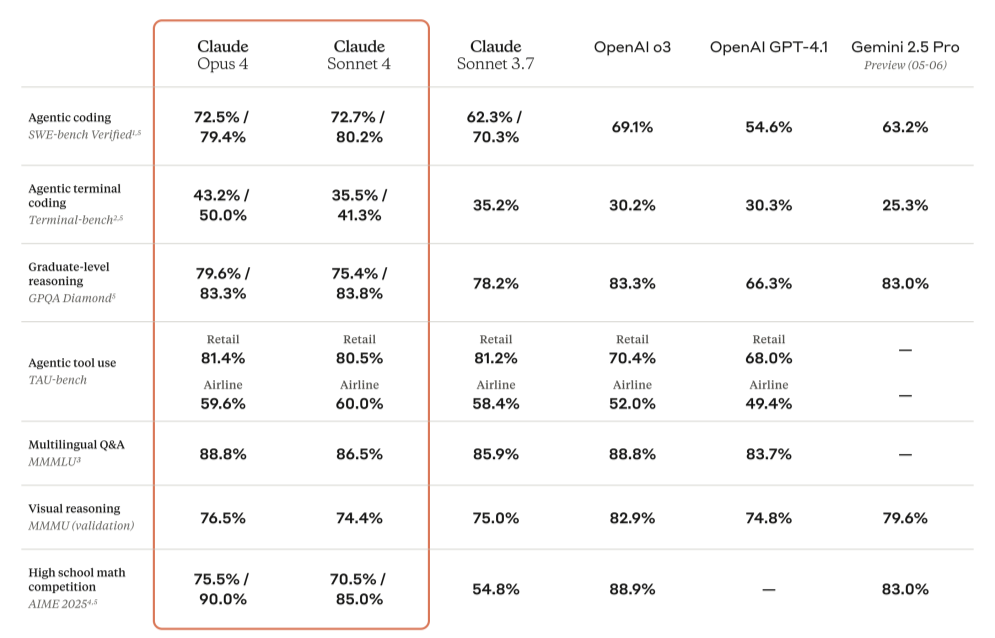
Whether you are drafting nuanced policy documents, exploring business strategy or untangling complex workflows, Claude delivers clarity with a near-human tone. It is also remarkably strong in code-related tasks, outperforming most LLMs on the SWE-bench (Software Engineering Benchmark) with 72.5% accuracy and scoring 43.2% on the Terminal-bench, making it one of the best options for teams who want to build lightweight internal tools or debug code with conversational precision.
Its core strength lies in deep, contextual understanding and coherent long-form outputs. However, it also has a limited integration ecosystem; mostly accessed through Claude.ai or via API (Application Programming Interface), with no native plugins or workspace embedding.
 Top article todayExcel-to-App Evolution: Why the Transformation Matters for SME’s
Gemini 2.5 Pro represents Google’s latest leap in multimodal intelligence. An AI model that does not just read text but also sees images, hears audio and understands video context. What sets Gemini apart is how deeply it is integrated into the Google ecosystem; Gmail, Docs, Sheets, Meet and more. For Australian SMBs already using Google Workspace, Gemini will not feel like a separate tool, it will become part of your daily workflow.
Gemini’s superpower is fluid interaction across content types. It can take a spreadsheet, a paragraph of instructions and a product image, and turn them into a pitch deck. It can summarise your last three meetings and use those notes to write your next client proposal. This makes it ideal for operational tasks, content generation, reporting and any role where speed of execution across multiple media types is essential.
This being said, Gemini still feels more like a reactive engine than a reflective partner; its responses can lean generic without detailed prompts. While its coding capabilities are strong, thanks to legacy PaLM (Pathways Language Model) integration, it requires more specific prompting to stay on topic and perform at its peak.
Features and Pricing Showdown
Technical Specifications: Claude vs Gemini
| Feature | Claude Opus 4 | Gemini 2.5 Pro |
| Developer | Anthropic | Google DeepMind |
| Release | May 2024 | December 2024 |
| Context Window | 200K tokens | 2M+ tokens |
| Multimodal Support | Text + limited images | Text, images, audio, video, code |
| Integration Strength | API-focused | Google Workspace native |
| Privacy Approach | Privacy-first design | Google ecosystem integrated |
Pricing Structure (API Access)
Claude Opus 4
- API Pricing:
- Input tokens: $15 per 1 million tokens
- Output tokens: $75 per 1 million tokens
- Consumer Access (Claude.ai):
- Free Tier: Daily usage limit (rotates based on demand)
- Pro Plan: USD $20/month for access to Claude Opus 4 via Claude.ai
- Billing Notes: API billing is handled via Anthropic’s partner platforms like Amazon Bedrock or via direct enterprise access. Token counts include formatting, instructions and metadata.
Gemini 2.5 Pro
- API Pricing:
- Input tokens:
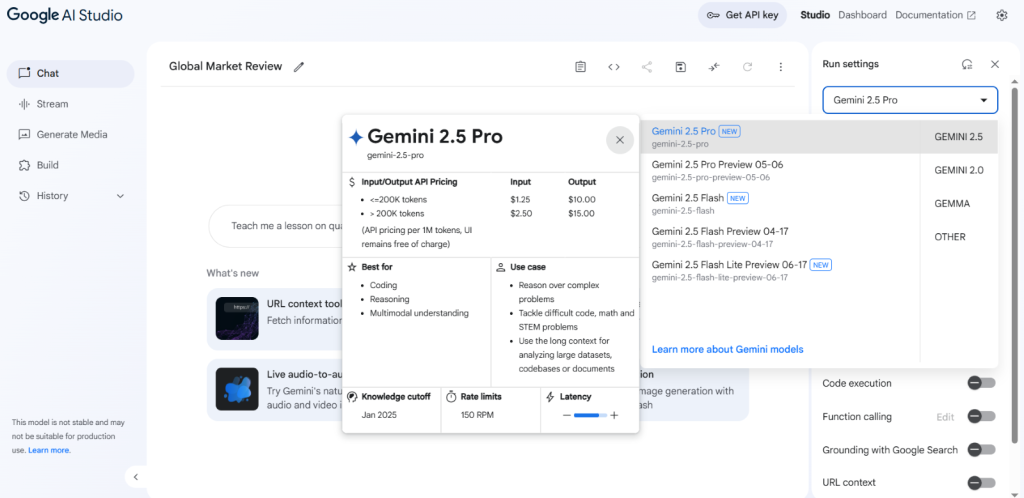
- $1.25 per 1M tokens (up to 200K context)
- $2.50 per 1M tokens (over 200K context)
- Output tokens:
- $10 per 1M tokens (standard output)
- $15 per 1M tokens (extended context models)
- Consumer Access:
- Free Tier: Access to Gemini 1.5 with usage limitations
- Premium Plan: Google One AI Premium at USD $29.99/month, includes Gemini 2.5 access and 2TB Google Drive storage
- Billing Notes: Charged via GCP – Google Cloud Platform (Vertex AI); ideal for businesses already operating within the GCP ecosystem.
If your business is cost-conscious and focused on long-form writing, policy review, summarisation or coding support, Claude Opus 4 offers better token efficiency at a lower entry cost, especially with its generous free tier for casual users. On the other hand, Gemini 2.5 Pro provides more operational value for teams embedded in the Google ecosystem, with lower token pricing and superior multimodal support. It becomes even more compelling when paired with Google Workspace tools and enterprise integrations. Ultimately, the better value depends on what you are automating and how integrated you want AI to be in your everyday workflows.
Making AI Work, Case by Case
The choice between Claude Opus 4 and Gemini 2.5 Pro often comes down to how each model integrates with your existing workflows and the type of work your business prioritises. Understanding these practical applications will help you move beyond theoretical comparisons to practical decision-making.
Content Creation & Strategy
When it comes to content strategy and creation, Claude Opus 4 is a powerhouse for businesses that rely on longer written content, strategic planning or client communications. Its nuanced tone makes it ideal for crafting polished emails, deep-dive reports and persuasive proposals. It excels at maintaining coherence across long documents, making it an excellent tool for agencies, legal teams and consultants.
 Read alsoStrait of Hormuz Chokehold Warning Lessons for Australian Businesses!
Gemini 2.5 Pro shines in environments where content needs to be created, iterated and distributed fast. Seamless integration with Google Docs, Gmail, and Slides allows team members to co-edit AI-generated content in real time. It also handles multimodal content better; combining text with charts, images or spreadsheets for reports, pitches or client presentations.
Coding & Technical Tasks
Claude Opus 4 has earned its reputation as one of the most capable coding assistants in the LLM space. It outperforms most other models in tasks like code generation, debugging, API integration and technical documentation. For SMBs with in-house developers or tech-driven services, Claude is an ideal companion.
Gemini 2.5 Pro, while not as precise in deep software engineering, is still highly effective for no-code/low-code workflows using Google Apps Script and for tasks like spreadsheet automation, data cleaning or connecting services via Google Cloud. It is particularly strong for SMBs, building automation across the Google ecosystem.
Operational Efficiency
For businesses looking to streamline daily operations, Gemini 2.5 Pro is the clear leader in workflow integration. It drafts emails, generates meeting summaries, auto-fills reports and helps teams extract insights from internal data; all without leaving the Workspace environment. If your team spends most of its day in Google tools, this model saves time instantly.
Claude Opus 4 offers a different kind of efficiency; ideal for roles requiring thoughtful analysis, strategic writing or long-form planning. It is excellent for complex research, customer communication and decision-making where language clarity and depth are important.
AI Matchmaking: Your Industry Cheat Sheet
Different industries have varying requirements for AI integration, from regulatory compliance to specific workflow needs. These recommendations are based on actual performance characteristics and typical business processes across sectors.
Get the best ones in your inbox — no spam, unsubscribe any time.
Professional Services (Legal, Consulting, Accounting)
Recommended: Claude Opus 4 – In industries where precision, tone and critical thinking are non-negotiable, Claude Opus 4 is a standout performer. It handles contract reviews, legal analysis, policy interpretation and complex communications with nuance and accuracy. The model’s ability to maintain context across long documents makes it ideal for preparing reports, whitepapers and detailed proposals; something professional services teams deal with daily.
Retail & Ecommerce
Recommended: Gemini 2.5 Pro – Retail and Ecommerce teams thrive on speed, clarity and consistency; where Gemini excels. The 2.5 model can generate product descriptions using visual input, manage and interpret inventory spreadsheets and support customer service workflows via autoreplies and helpdesk documentation. With its tight Google Sheets integration and ability to scale content creation, Gemini saves teams valuable time while maintaining brand tone.
Creative Agencies & Marketing
Recommended: Gemini 2.5 Pro – For teams juggling brand campaigns, visual storytelling and high-volume content output, Gemini 2.5 Pro is the clear winner. Its multimodal capabilities make it easier to produce campaign assets that include both copy and visuals. Combine it with Google Workspace, and teams can move from ideation to presentation much faster. It is a must for time-sensitive client work.
Technology & Software Companies
Recommended: Claude Opus 4 – For startups and dev teams building software or integrating APIs, Claude Opus 4 offers unmatched support in coding performance and documentation. Its accuracy in software engineering benchmarks makes it the go-to choice for developers. It also excels at explaining technical processes in plain English, making it a bridge between your engineering and operations teams.
Comparison for Australian SMBs
| Feature/Use Case | Claude Opus 4 | Gemini 2.5 Pro |
| Best For | Operational tasks, Google Workspace integration, multi-modal content | Fast, collaborative, visually friendly asset creation |
| Core Strength | Long-form reasoning, contract review, complex summarisation | Multimodal support, real-time workflows, and spreadsheets into visual intelligence |
| Weakness | Limited integration, no native Workspace tools | Generic tone without fine prompting, Google dependency |
| Content Creation | Auto email replies, Gmail-based helpdesk prompts | Deep, structured, high-context writing |
| Coding Tasks | Best-in-class logic and debugging | Strong low-code tools, App Scripts, cloud function extensions |
| Customer Support | Clear response drafting, FAQs, support policies | Cross-functional teams need speed and flexibility |
| Marketing | Proposal writing, brand tone control | Campaign ideation, emails, image & caption generation |
| Team Size Suitability | Neatly embedded into Google Docs, Sheets, Meet, gmail | Lean teams need accuracy and thoughtfulness |
| Integration Environment | Web interface and API only | Neatly embedded into Google Docs, Sheets, Meet, Gmail |
| Data Privacy Focus | High. Strong ethical boundaries, no workspace data sharing | Medium. Works inside Google systems, some data trade-offs |
| Free Tier | Generous daily access. Accessibility is based on current demand. | Limited access. Not very effective without a pro plan. |
| Pro Plan (Consumer) | $20 USD/month (Claude Pro) | $29.99/month (Google One AI Premium) |
| API Token Pricing | $15 input / $75 output per million tokens | $1.25-$2.5 input / $10-$15 output per million tokens |
| Unique Insight | Feels like a co-pilot that reasons with you | Feels like an embedded team member inside your workflow |
Mindset is more important than the AI Model
Now that we have broken down the value of both Opus 4 and Gemini 2.5 Pro for Aussie SMEs, which one do you think delivers better value? If you ask us at FUZN, we tell all of our clients that it depends on how you work and what your mindset is towards the problems you face within your workflows. If your team could thrive with deep thinking, long-form writing or strategic planning, Claude Opus 4 will feel like a thoughtful co-pilot for your entire team. However, if you live and thrive inside Google Workspace and want to speed up your day-to-day operations, Gemini 2.5 Pro would be your ideal native AI assistant.
The real takeaway is that the best value from any AI model, not only Opus 4 and Gemini 2.5 Pro, is created through intentional use. The businesses seeing meaningful ROI from any LLMs are not just choosing the right tool; they are choosing the right approach. These companies, both globally and within Australia, are running prompt training workshops for their teams and building libraries of tested prompts for daily workflows. This not only helps them address the issue faster with their respective AI models but also helps them use tokens much more efficiently, saving them on AI expenditure. They also invite AI experts to uncover opportunities within their operations. Instead of delving into the benefits of AI, they start small, validate fast and scale with data, which has not only reduced their risk but also helped them lead the AI movement within their domains.
In other words, they are not waiting for AI models to magically deliver results. They are teaching their teams how to talk to AI and are actively learning what it can do to make their workflows better. We strongly believe at FUZN that any AI is only as smart as your strategy. Whether you choose Claude Opus 4 or Google’s Gemini 2.5 Pro, your greatest advantage will not come from these models; it will come from how intentionally you use them. The most important value you can create is to just start with a model and start experimenting with it.
 Read alsoWhy Most Australian SMEs Use Only 20% of What They Are Paying For Zoho CRM
FAQs
What are tokens in AI, and why do they matter for pricing?
Tokens are units of text processing; roughly 3-4 characters or 0.75 words. A 1,000-word document uses approximately 1,300-1,500 tokens. Understanding token usage helps predict costs, especially for businesses processing large volumes of content.
Claude Opus 4 vs Gemini 2.5, which is better for different company sizes?
Solo entrepreneurs/micro businesses (1-5 employees): Claude Opus 4 for strategic work, Gemini 2.5 Pro if heavy Google Workspace users
Small businesses (6-50 employees): Gemini 2.5 Pro often wins due to collaboration features and cost efficiency
Medium businesses (51-200 employees): Consider both; Claude for strategic teams, Gemini for operational teams
How do I evaluate which model works better for my business?
Run parallel tests with both models using identical prompts for your most common tasks.
Measure:
– Quality of outputs
– Time to complete tasks
– Integration with existing workflows
– Team adoption rates
– Cost per use case
Are there any Australian-specific considerations while choosing an AI Model?
Both Opus 4 and Gemini 2.5 models comply with Australian privacy laws, but consider:
– Data residency requirements for sensitive industries
– Integration with local business software
– Support for Australian English and business terminology
– Time zone considerations for customer support.
Can I use both Gemini & Claude models simultaneously?
Yes, many businesses use multiple AI models for different purposes. This approach, called ‘model orchestration’, allows you to leverage each model’s strengths while managing costs effectively. By combining both, you gain flexibility, reduce over-reliance on a single system and can optimise cost vs performance across workflows.
What about data security and privacy?
Claude Opus 4 emphasises data privacy with opt-out training policies and strong security measures. Gemini 2.5 Pro operates within Google’s ecosystem, which may concern businesses with strict data sovereignty requirements. Review each provider’s data handling policies carefully
The AI landscape evolves rapidly. This comparison reflects capabilities as of June 2025. Test both models with your specific use cases before making final decisions.