




You’ve probably noticed that “AI agent” and “AI chatbot” are often used interchangeably. A vendor demo calls their chatbot an “agent.” A tech article describes agents but shows a screenshot of a chat interface. It’s confusing. (Disclaimer: It’s getting a lot more convoluted though – all major vendors have been adding agent mode in chatbots recently, and it’s going to get a lot more confusing in the future. Understanding the distinction between AI Agent vs AI Chatbot is crucial.)
Here’s the reality: they’re fundamentally different technologies that solve different problems. Mixing them up is like calling a calculator a computer. Sure, both do maths, but one is vastly more capable than the other.
If you’re considering AI for your business, understanding this difference isn’t just academic. It determines whether you get a helpful assistant or a transformative tool that actually does work for you.
Let’s clear up the confusion once and for all.
What Is an AI Chatbot?
An AI chatbot is a conversational interface powered by AI. You type or speak to it, and it responds. Think your ChatGPTs and Geminis of the world, customer service bots on websites, or virtual assistants that answer questions.
What chatbots do:
- Respond to queries in natural language
- Provide information from their knowledge base
- Guide users through predefined flows
- Answer frequently asked questions
- Escalate to humans when stuck
What chatbots don’t do:
- Take action on your behalf
- Access multiple systems independently
- Make decisions and execute them
- Work autonomously without human input
- Adapt their approach based on outcomes
Example: You’re on a real estate website and ask the chatbot, “What properties do you have in Melbourne under $800k?” The chatbot searches the database and displays relevant listings. You ask follow-up questions, it answers. Useful? Absolutely. But you’re still doing all the work. The chatbot is just a smarter way to access information.
The key limitation: chatbots are reactive. They wait for you to ask, then respond. They don’t initiate, don’t plan, and don’t execute tasks independently. And for how far we’ve come with RAG and access to sources, chatbots are pretty dumb by just themselves. Oh well.

What Is an AI Agent?
An AI agent is fundamentally different. It’s an autonomous system that perceives its environment, makes decisions, and takes actions to achieve specific goals. You give it an objective, and it figures out how to accomplish it, often without further input from you.
What AI agents do:
- Take action across multiple systems
- Break down complex tasks into steps
- Make decisions based on context and data
- Execute workflows autonomously
- Learn and adapt based on outcomes
- Chain together multiple tools and APIs
What makes them “agents”:
- Autonomy: They work independently
- Goal-oriented: They pursue objectives, not just respond to queries
- Adaptive: They adjust their approach based on results
- Multi-step: They execute sequences of actions
- Tool use: They access and use various systems
Example: You tell an AI agent, “Find qualified leads for our new commercial property in Melbourne, reach out to them with personalised messages, schedule viewings for next week, and add confirmed appointments to my calendar.” The agent searches business databases, identifies potential tenants matching the property profile, crafts personalised outreach emails, monitors responses, coordinates availability, books appointments, and updates your calendar. You check back later to find five viewings scheduled. The agent did the work.
 Top article todayExcel-to-App Evolution: Why the Transformation Matters for SME’s
See the difference? The chatbot helps you work. The agent does work.
The Core Differences: AI Agent vs Chatbot
Let’s break down the fundamental distinctions:
1. Interaction Model
- AI chatbots: Conversational and reactive. They respond to your inputs within a chat interface. You ask, they answer. You request, they provide.
- AI agents: Goal-driven and proactive. You set an objective, and they autonomously work toward it. They may report back when done, but they don’t need constant conversation to function.
2. Decision-Making
- AI chatbots: Limited decision-making. They choose how to respond to your question, but they don’t make operational decisions or take actions beyond the conversation.
- AI agents: Complex decision-making. They evaluate options, choose approaches, determine when to use which tools, and adjust strategies based on outcomes.
3. Action Capability
- AI chatbots: Primarily informational. They might trigger simple actions (like creating a ticket or booking an appointment), but these are typically single, predefined actions.
- AI agents: Operational. They execute multi-step workflows across systems, coordinate between tools, and chain actions together to accomplish objectives.
4. Memory and Context
- AI chatbots: Maintain conversation history. They remember what you said earlier in the chat to provide coherent responses.
- AI agents: Maintain task state and working memory. They remember where they are in a complex workflow, what they’ve tried, what worked, and what they still need to do.
5. Human Involvement
- AI chatbots: Require continuous human interaction. The conversation is the work.
- AI agents: Minimise human involvement. You set the goal, they handle execution, you verify results.
Understanding Agentic Workflows
When we talk about agents, we’re really talking about agentic workflows. These are sequences of actions where the AI makes decisions about what to do next based on the current state.
Traditional workflow: Step 1 → Step 2 → Step 3 → Done. Always the same path.
Agentic workflow: Goal → Assess situation → Choose action → Execute → Evaluate outcome → Decide next action → Repeat until goal achieved.
Example agentic workflow for property management:
Goal: Collect overdue rent from tenants with balances over $500.
- Agent queries property management system for overdue accounts
- For each account, agent checks payment history and communication records
- Based on history, agent chooses approach:
- Good history, first late payment → Send friendly reminder
- Multiple late payments → Send formal notice
- Significant history of issues → Flag for property manager review
- Agent sends appropriate communication
- Agent schedules follow-up check in 3 days
- At follow-up, agent checks if payment received
- If yes, mark resolved and send thank you
- If no, escalate based on escalation rules
- Agent documents all actions in system
Notice the decision points? The agent adapts its approach based on context. A chatbot would just answer questions about overdue rent. An agent handles the entire process.
Autonomous Agents: True Independence
When we talk about autonomous agents, we mean systems that can operate independently for extended periods without human supervision.
Key Comparisons: AI Agent vs AI Chatbot
Understanding the Difference: AI Agent vs AI Chatbot
Virtual agent vs chatbot
A virtual agent is usually what people mean when they describe an AI agent: a proactive, goal-driven virtual collaborator that can act across systems to get work done. A chatbot is a conversational, reactive interface: useful for answering questions, guiding users through flows and surfacing information, but not for independently executing multi-step tasks. If you want someone to autonomously pursue objectives — find leads, schedule meetings, reconcile accounts — you need a virtual agent (agentic workflow). If you just need conversation, FAQs or guided support, a chatbot is the simpler, appropriate choice.
Characteristics of autonomous agents:
- Self-direction: They determine their own action sequences to achieve goals.
- Environmental awareness: They monitor relevant systems and data to understand context.
- Adaptability: They adjust approaches when initial strategies don’t work.
- Persistence: They continue working toward goals over time, even across sessions.
- Learning: They improve based on outcomes and feedback.
Example: A legal practice implements an autonomous agent for contract review. The agent monitors the contracts folder, automatically reviews new contracts for standard clauses, flags unusual terms, checks compliance with company policies, extracts key dates and obligations, updates the contract management system, and notifies relevant team members. It runs 24/7, processing contracts as they arrive, without anyone starting it or checking on it constantly.
This is different from a chatbot where a lawyer uploads a contract and asks, “What are the key risks here?” With a chatbot, the lawyer still has to initiate, upload, ask the right questions, and take action on the responses. The autonomous agent handles the entire workflow.
Dynamic AI Agents: Adapting to Change
Dynamic AI agents take autonomy further. They don’t just follow pre-programmed decision trees, they adapt their behaviour based on changing conditions and learning.
What makes an agent dynamic:
- Context sensitivity: They adjust behaviour based on real-time data (time of day, workload, urgency, user preferences).
- Learning loops: They analyse outcomes and refine their approaches over time.
- Strategy variation: They try different approaches for similar problems based on what’s worked before.
- Environmental adaptation: They adjust to changes in systems, APIs, or business rules without being reprogrammed.
Example: A dynamic AI agent for customer support in e-commerce learns that customers asking about order status on weekends are more likely to be satisfied with automated updates, but weekday inquiries often indicate urgent issues requiring human intervention. The agent adapts its escalation behaviour accordingly. It also learns which product categories generate the most returns and proactively provides additional information when those products are purchased.
 Read alsoTool-Call Reliability in Production LLM Agents
Decision Trees: Chatbots vs Agents
Understanding how each makes decisions clarifies the distinction:
Chatbot Decision Tree
User input → Intent classification → Retrieve relevant information → Generate response → Wait for next input
The decision tree is shallow and linear. “What is the user asking?” and “How should I respond?”
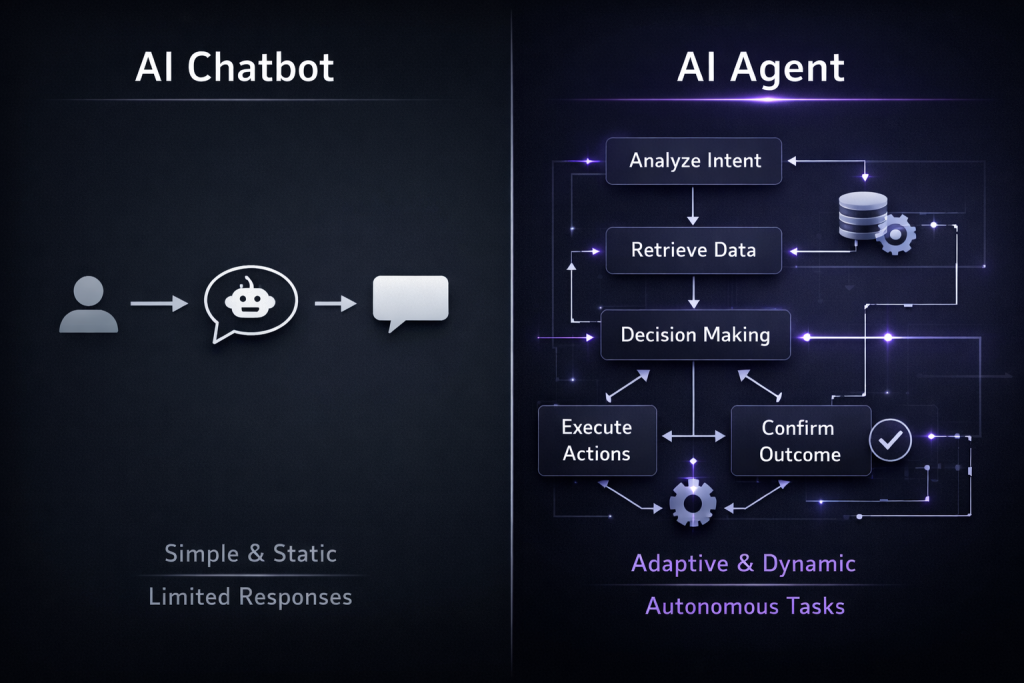
AI Agent Decision Tree
Goal received → Analyse current state → Identify sub-goals → For each sub-goal: Determine required actions → Select appropriate tool → Execute action → Evaluate result → Adjust plan if needed → Move to next sub-goal → Verify goal completion → Report results
The decision tree is deep and branching. At each step, the agent evaluates multiple factors and chooses from multiple possible paths.
Concrete example: “I need to prepare the monthly financial report.”
Chatbot approach: “I can help you prepare the financial report. What information do you need?”
Then it answers questions, provides templates, explains processes. You do all the work.
Agent approach: The agent accesses your accounting system, extracts transaction data, categorises expenses, calculates key metrics, compares to previous months and budget, identifies anomalies, generates charts and tables, formats the report according to your template, adds commentary on significant variances, and emails you the completed report for review.
The agent made dozens of decisions: which data to pull, how to categorise transactions, which metrics matter, how to visualise data, what constitutes an anomaly worth noting. All without asking you.
Failure Modes: What Goes Wrong
Understanding failure modes helps you implement appropriate safeguards.
Get the best ones in your inbox — no spam, unsubscribe any time.
Chatbot Failure Modes
- Misunderstanding intent: User asks about “leasing options,” chatbot thinks they mean car leases instead of property leases.
- Knowledge gaps: Chatbot encounters a question outside its training data and provides incorrect information confidently.
- Context loss: In long conversations, chatbot forgets earlier context and provides contradictory information.
- Scope creep: User asks the chatbot to do something it can’t, leading to frustration when it only provides information.
These failures are usually obvious and low-risk. The worst outcome is typically a poor user experience.
Agent Failure Modes
- Misaligned objectives: Agent interprets goal incorrectly and optimises for the wrong outcome. Example: “Reduce customer complaints” could mean either improve service or stop tracking complaints.
- Cascading errors: Agent makes a wrong decision early in a workflow, and subsequent actions compound the error.
- Tool misuse: Agent uses a tool inappropriately because it misunderstands what the tool does or when to use it.
- Infinite loops: Agent gets stuck repeating the same actions without recognising they’re not working.
- Overstep boundaries: Agent takes actions beyond its intended scope because the guardrails weren’t clear.
These failures can have real business impact. An agent that sends emails, updates databases, or processes transactions can cause damage if it fails.
Governance: Managing AI Agents Safely
Because agents take real actions, governance is critical. You need frameworks to ensure agents operate safely and within boundaries.
Key governance principles:
1. Clear Boundaries
Define what agents can and cannot do. Which systems can they access? What actions are permitted? What requires human approval? Example: A sales agent can update contact records and send templated emails but cannot access financial data or send custom communications about pricing.
2. Human-in-the-Loop for Critical Actions
Require human approval for high-stakes decisions. Agents handle routine actions autonomously but flag significant ones for review. Example: An agent can schedule standard maintenance but must get approval before authorising repairs over $5,000.
3. Audit Trails
Log everything agents do. When they act, what data they accessed, what decisions they made, and what outcomes resulted. This enables accountability, debugging, and continuous improvement.
4. Rollback Capabilities
For actions that can be undone, implement rollback. If an agent makes a mistake, you can reverse it. Example: An agent that updates inventory quantities maintains a log so incorrect updates can be reverted.
5. Testing and Staging
Test agents in safe environments before production deployment. Use synthetic data and staging systems to validate behaviour.
6. Gradual Autonomy
Start with agents that suggest actions for human approval. Once proven reliable, gradually increase autonomy.
7. Monitoring and Alerts
Continuously monitor agent behaviour for anomalies. Alert humans when agents encounter unexpected situations or exceed normal parameters.
Example: If a customer service agent suddenly escalates 10x more conversations than usual, alert the team to investigate.
When to Use What
So when do you need a chatbot versus an agent?
 Read alsoTop 5 No Code Automation Platforms for 2026
Choose AI Chatbots When
- Your goal is to make information more accessible
- Users need help navigating your systems or finding answers
- You want to provide 24/7 customer support for common questions
- The interaction itself is the value (support, guidance, conversation)
- You need a front-end interface for users to access AI capabilities
Choose AI Agents When
- You need work done, not just questions answered
- Tasks involve multiple steps across different systems
- Processes are repetitive and rule-based but complex
- Speed and scale matter (handling more volume than humans can)
- You want to reduce manual work and free up staff for higher-value tasks
Use Both When
Many businesses benefit from both. A chatbot serves as the conversational interface, while agents handle execution.
Example: A property management company uses a chatbot for tenant inquiries. When a maintenance request comes through the chat, the chatbot logs it and triggers an agent. The agent checks contractor availability, schedules appropriate tradesperson, sends confirmation to tenant, creates work order in system, and follows up after completion. The chatbot handles communication, the agent handles coordination and execution.
Industries Benefiting from AI Agents
While chatbots work across most industries, autonomous agents deliver particular value in:
Professional services (legal, accounting, consulting): Automating document processing, compliance checks, research, and report generation. Agents handle the repetitive analytical work while professionals focus on strategy and client relationships.
Real estate and property management: Coordinating showings, managing maintenance workflows, handling tenant communications at scale, processing applications, and managing lease renewals.
Financial services: Monitoring transactions for anomalies, processing loan applications, managing compliance documentation, reconciling accounts, and generating regulatory reports.
Healthcare administration: Scheduling optimisation, insurance verification, claims processing, patient follow-ups, and medical records management.
E-commerce and retail: Inventory management, order processing, customer lifecycle management, return handling, and supplier coordination.
Marketing agencies: Campaign monitoring and optimisation, reporting automation, content distribution, lead qualification, and client communication workflows.
The pattern? Industries with complex, multi-step workflows that require coordination across systems but follow logical rules.
The Future: Agentic AI
We’re moving toward increasingly agentic AI. Not just tools that answer questions, but systems that accomplish objectives. This shift represents a fundamental change in how we work with technology.
Instead of using software to do tasks faster, we’re delegating entire processes to AI systems that figure out how to accomplish them.
The implications are significant. Teams become force multipliers. Small companies compete with large ones. Businesses that adopt agentic AI gain substantial efficiency advantages over those that treat AI as just smarter search.
Understanding the distinction between chatbots and agents positions you to leverage AI appropriately. Use chatbots for conversation and assistance. Deploy agents for execution and automation.
Build Your AI Agent with FUZN
Ready to move beyond chatbots and implement AI agents that actually do work for your business?
At FUZN, we specialise in designing and building custom AI agents tailored to your specific workflows. We work with businesses across Australia and the US to identify high-impact opportunities for agentic AI and implement solutions with appropriate governance and safeguards.
Our approach:
- Discovery: We analyse your workflows to identify where agents deliver the most value
- Design: We architect agentic systems with clear boundaries, decision logic, and failure handling
- Build: We develop and integrate agents with your existing systems
- Govern: We implement audit trails, human-in-the-loop processes, and monitoring
- Optimise: We continuously refine agent behaviour based on outcomes
We don’t just build technology. We ensure your team understands how agents work, how to oversee them, and how to expand their capabilities over time.
Build your AI agent with FUZN. Get in touch for a consultation, and let’s discuss how agentic AI can transform your operations.