

Logistics Automation in Australia: Why Your Trucking Business Stops Growing Even When Demand Is Rising
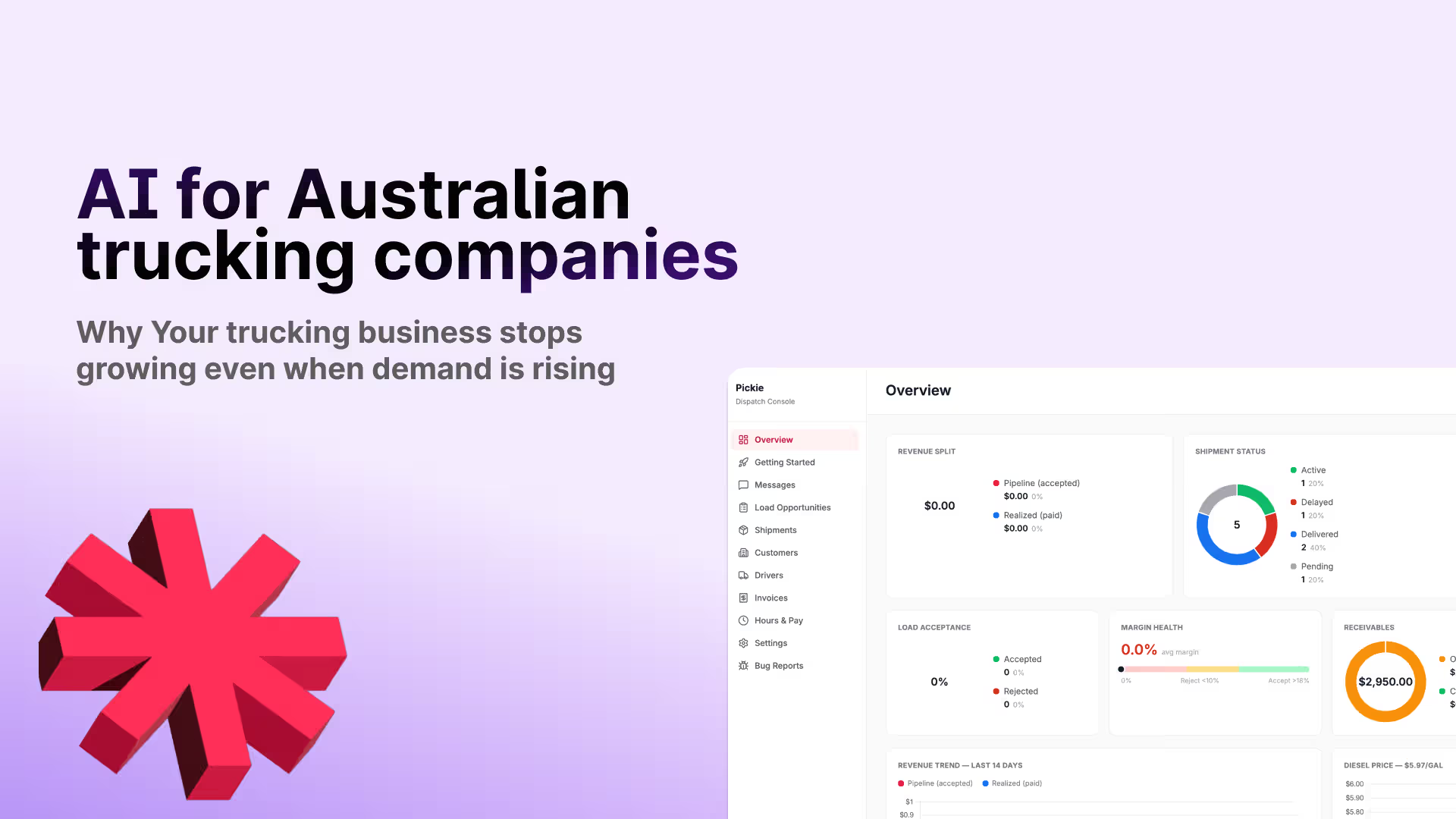




The biggest barrier to growth for Australian trucking companies is not finding more loads. It is the operational ceiling that most owners do not realise they have already hit.
Have you ever finished a 12-hour workday feeling exhausted, only to realise you never actually spent time growing your business? You answered calls, replied to WhatsApp messages, coordinated drivers, checked on delayed shipments, chased proof of delivery, followed up on invoices and dealt with unexpected issues that demanded immediate attention. This daily grind is a clear sign for you to explore options on logistics automation in Australia.
Your day has disappeared and tomorrow, you will probably do it all again.
If that sounds familiar, you are not alone, and most business owners and dispatchers face the same reality. This particular issue is becoming one of the defining challenges for Australia’s trucking industry. Road freight carries around three-quarters of Australia’s domestic freight, making it the backbone of the nation’s supply chain.
Yet despite continued demand for transport services, many trucking companies find themselves working harder every year without feeling like they are moving forward. Rising fuel costs, driver shortages, tighter compliance requirements and increasing customer expectations all contribute to the pressure. However, after spending months researching transport operations while developing logistics automation solutions in Australia, we have come to believe those are not the problems that ultimately stop businesses from growing.
They are just the symptoms. The real problem lies inside the business process itself and it is your operational ceiling.
 Top article todayExcel-to-App Evolution: Why the Transformation Matters for SME’s
Growth does not usually fail because of demand
Most business owners assume growth slows when there are not enough customers, but in reality, the opposite is often true.
Business is good. The phone keeps ringing; brokers keep sending opportunities and existing customers want more capacity. The challenge is not finding work; it is finding the time and operational capacity to handle it.
Think back to when your business had only a handful of trucks. You probably knew exactly where every vehicle was, which customers needed updates and what every driver was working on. Decisions were quick because information was easy to access.
Then your business grew; five trucks became ten and ten trucks slowly became twenty. Each new customer created more conversations, each additional truck introduced another driver to coordinate and every shipment generated another chain of updates, documents, phone calls and decisions.
Revenue grew steadily, but operational complexity grew exponentially. At some point, those two lines crossed and that is the moment your businesses unknowingly reach its operational ceiling.

The busiest person in the business is often the biggest bottleneck
Here is an uncomfortable question, “Who makes most of the important operational decisions in your business?” If the answer is “me,” then you have probably already experienced the operational ceiling.
As companies grow, owners naturally become involved in everything. A broker needs confirmation before awarding a load. A driver calls to report an unexpected delay. A customer wants an updated ETA. Someone needs approval before sending an invoice. Another shipment needs to be priced before accepting it. None of these decisions are particularly difficult, the problem is that they all arrive at once.
One interruption becomes twenty and without noticing, your role changes from growing the business to keeping the business running. Ironically, success creates the very bottleneck that eventually slows future growth.
 Read alsoIntroducing Pickie: Dispatch over WhatsApp for Small Fleets
Also Read: Healthcare Automation in 2025: Strategy, ROI & Real Outcomes
Why hiring more people is not always the answer
When operations become overwhelming, the instinctive response is to hire, another dispatcher, another administrator, another operations coordinator. Sometimes that is absolutely the right decision, especially if good service is your priority.
However, hiring people does not automatically remove complexity. In many cases, it simply spreads it across more people. More employees create more communication, more communication creates more handovers and more handovers create more opportunities for information to be delayed, misunderstood or lost.
At the same time, the transport industry faces a significant workforce challenge. Recent IRU industry reporting highlights an ongoing shortage of truck drivers across Australia, with workforce pressures expected to intensify over the coming years as experienced drivers retire faster than new ones enter the industry. That makes solving operational problems purely by adding people increasingly difficult.
The practical question is not whether businesses need talented people. It is whether talented people should spend their day doing work that technology can already handle.
If software has improved so much, why does work still feel manual?
Walk into almost any transport business globally, today and you will find software everywhere; dispatch systems, accounting platforms, GPS tracking, fleet management tools, customer portals and digital documentation.
Get the best ones in your inbox — no spam, unsubscribe any time.
Yet ask most owners how their day feels and you will hear a different story; work is still manual. Why? Because the real work does not happen inside software, it happens inside conversations.
A broker sends a load request through WhatsApp. Someone manually copies the details into another system. The driver is contacted separately, the customer requests updates through email, proof of delivery arrives later and the invoice is generated elsewhere.
Each tool performs its own task but very few understand the conversation connecting one step to the next. Owners are not managing software; they are managing the gaps between software. This is your technological disadvantage.
Also Read: AI Agent vs. AI Chatbot – Why It’s Not the Same
AI developments is re-shaping logistics automation in Australia
For years, automation required businesses to redesign their operations around technology. Today’s AI is changing that equation. Instead of asking people to work differently, modern AI can work within the conversations businesses already have. It can read emails, interpret WhatsApp messages, extract information from documents, identify shipment details and trigger operational workflows without someone manually re-entering the same information over and over again. This can be a fundamental shift, in helping you to grow the business
The goal is not to replace dispatchers or business owners; it is to remove repetitive administrative work so people can focus on decisions that genuinely require experience and judgement.
At FUZN, this is the opportunity we see every day as a logistic automation agency in Australia working with operational businesses. The most valuable AI is not the one with the flashiest interface or built on the best models but it is the one people barely notice because it is quietly removing friction behind the scenes.
 Read alsoHow Workflow Automation Is Reforming Australian Construction Operations

Biggest fleets do not help your business win in 2026
For years, competitive advantage in transport often came from adding more trucks. Now, it comes from making faster decisions.
Imagine two businesses competing for the same load. One takes thirty minutes to respond because someone has to gather information manually. The other responds in five because operational data is already connected. Which business wins?
Or consider invoicing for that matter. A business that sends invoices immediately after proof of delivery improves cash flow without finding a single new customer. A dispatcher who spends less time answering routine status requests has more time to secure profitable freight. An owner who is not glued to their phone can finally focus on building relationships instead of constantly reacting to operational issues. None of these improvements come from working harder, they come from reducing operational friction.
Also Read: Australia’s Top AI Agency: Our Story of Automation
The future belongs to businesses that remove their operational ceiling
Every growing business eventually reaches a point where the challenge is no longer demand. It is capacity; not truck capacity, but operational capacity.
The businesses that continue to scale will be those that recognise this shift early. They will invest in systems that reduce repetitive work, connect fragmented information and help people make better decisions instead of simply creating more administration.
At FUZN, this is the philosophy driving our work in logistics automation across Australia and it is the thinking behind Pickie; our new operational platform designed specifically for modern logistics businesses.
We do not believe transport companies need another dashboard, we believe they need better operational infrastructure. Because growth should not be limited by how many conversations you can manage in a day. It should be defined by how confidently your business can respond, decide and execute as it scales.
Every growing business eventually reaches an operational ceiling. The companies that continue to grow are the ones that remove it before it becomes a barrier.