

Construction Productivity in Australia: Build More Without Burning Out the People Who Build It




Australia needs to build more; more homes, more infrastructure, more energy projects, more transport and more of the physical foundations a growing economy depends on. Underneath this ambition sits a genuine construction productivity problem and it raises an uncomfortable question; who is going to build it?
Australia’s construction industry is already dealing with a persistent construction productivity problem and a skilled labour shortage. Infrastructure Australia estimates the infrastructure workforce could face a shortage of more than 300,000 workers by 2027, while construction productivity remains well below its long-term trajectory.
The Productivity Commission has reached a similar conclusion from a different angle. Its research found that Australian housing construction now completes roughly half as many homes per hour worked as it did in 1995 and even after accounting for improvements in size and quality, labour productivity in housing construction has declined by 12% over the same period.
A deadening effect – Danielle Wood, Chair, Productivity Commission, on the impact of regulatory red tape on home-building productivity
This is only part of the picture, though. The Australian Constructors Association has pointed out that the workforce numbers hide real regional variation, as ACA CEO Jon Davies put it, there is capacity in the market right now to deliver many infrastructure projects, even as the housing sector strains supply elsewhere.
So, Australia is facing a difficult equation; we need to build more, we have limited skilled capacity and simply asking the people we already have to work harder is not a productivity strategy.
Technology is often presented as the answer and it genuinely can be but perhaps we have been asking the wrong question. Instead of asking what we can automate, construction leaders should also be asking what can be removed from the people who actually need to build. Because construction is still, fundamentally, a people business.
The People Are the Capability
A construction project can be designed digitally. Schedules can live in cloud platforms, drawings can be shared instantly, AI can analyse documents and software can track costs, procurement and project progress. Despite all of these, the building still happens because people know what to do; they inspect sites, solve problems that were not in the original plan, recognise when something does not look right and coordinate subcontractors as conditions change. They manage clients, suppliers and teams, bringing years of experience to situations no system can fully predict.
That human capability is one of construction’s greatest assets and one of the most constrained parts of the construction workforce. A project manager has only so many hours in a day. A site supervisor has only so much attention. A skilled tradesperson can only compensate for poor coordination for so long. And yet much of the pressure placed on these people has very little to do with the actual craft of construction, it comes from everything surrounding it.
 Top article todayExcel-to-App Evolution: Why the Transformation Matters for SME’s
The Productivity Problem Is not Just About People
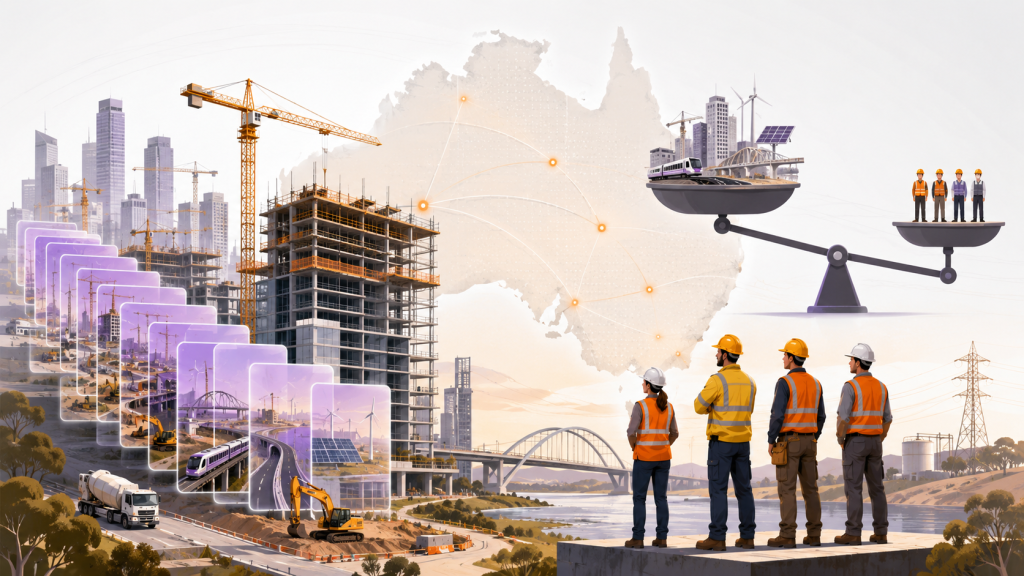
When construction productivity is discussed, the conversation usually moves quickly towards labour; we need more workers, more skilled workers, better training, better retention. All of this is true. However, there is another question worth asking, how much of the capacity we already have is being consumed by work that should not require so much human effort in the first place?
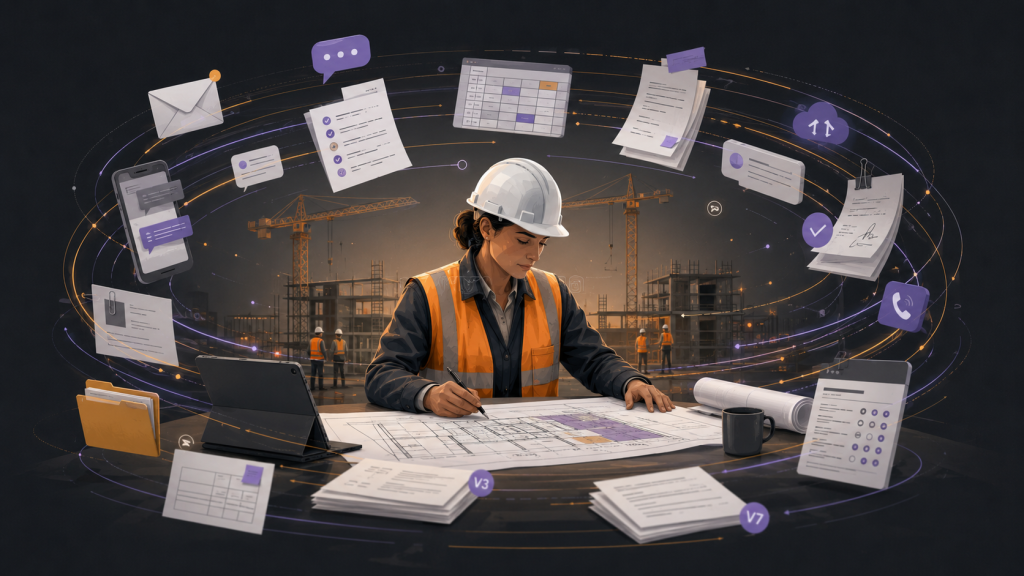
Consider what a project manager is actually valuable for like making decisions, managing risk, solving problems, negotiating and keeping a project moving when reality diverges from the plan. Now consider what fills the rest of their day; searching through emails for the latest drawing, chasing an approval, copying information from one system into another, updating spreadsheets and trying to work out which version of a document is current.
This is all real work. But these are not the work which actually requires that person’s expertise, it is the work around the work. This distinction needs to change how we should think about construction productivity.
Also Read: Why is Your Google Ads Campaign and SEO not converting in 2026?
The Real Opportunity Is the Work Around the Work
Construction automation is often discussed as though the goal is to automate the work itself. However, much of the immediate opportunity sits around it; the email that needs to become a task, the message that needs to become a project update, the approval that needs to be chased, the document that needs to reach the right person and the change that needs to be recorded across multiple systems.
These are not necessarily complex problems; they are coordination problems and coordination consumes human capacity. This is where technology can make a profound difference without replacing the people doing the work.
Do not automate the people. Automate the friction around the people. This should be one of the fundamental principles behind construction technology.
Technology Adoption Is not the Same as Productivity
The Australian construction industry is already moving in this direction. Deloitte’s 2026 research found that 56% of surveyed construction and engineering businesses use data analytics, 50% use cloud construction management software, 47% use mobile applications and 46% use AI or machine learning, yet only 16% were classified as having advanced digital capability.
This gap matters. It reflects a broader wave of digital transformation in construction but adoption alone does not guarantee results, because having technology is not the same as benefiting from it. A business can have multiple software platforms and still depend on people to move information between them. It can have dashboards and still need someone to call around the project to understand what is really happening. It can introduce AI in construction workflows while leaving experienced project managers buried in administration.
More technology does not automatically create more productivity. Connected technology can remove friction; disconnected technology can create another layer of it. The objective should not be to make a construction company more digital for its own sake; it should be to make the people inside the business more capable.
Also Read: Automations Your Organisation Can Deploy Today
 Read alsoLogistics Automation: What Could Your Business Do With 20 Extra Hours Every Week?
Give People Their Capacity Back
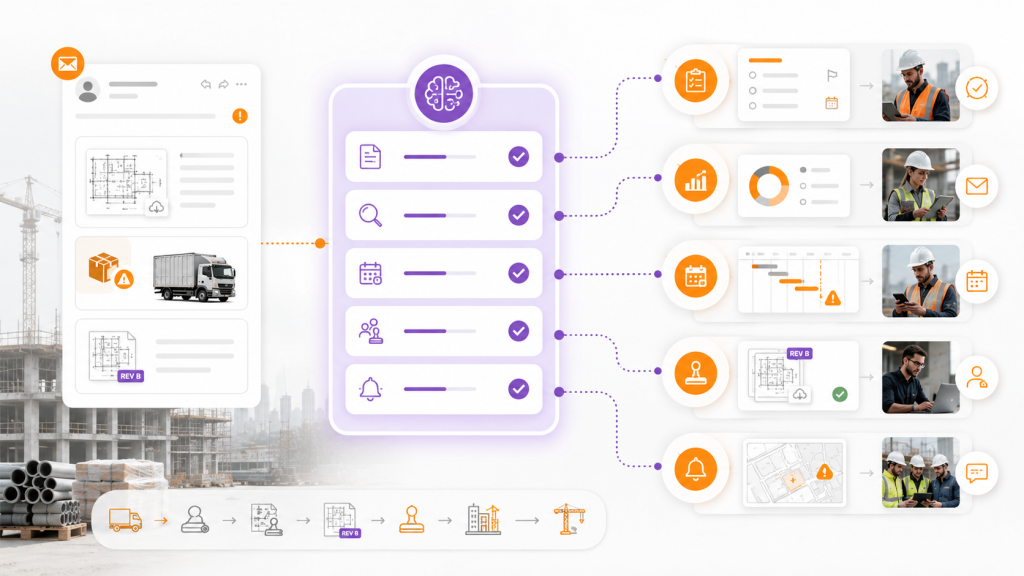
Imagine a project manager receiving an email about a delayed material delivery. The message contains the project name, the affected material, the expected delivery date and the reason for the delay. In a fragmented workflow, someone still has to interpret the message, identify the project, update the relevant system, notify the right people and check whether the delay affects another activity.
The information was already there. The problem was getting it from information to action. This is where intelligent workflow automation becomes valuable, not as a replacement for construction project management but as its support system. A well-designed system can recognise the information, understand its context, connect it to the right project and initiate the appropriate next step.
The human does not disappear. The human becomes more useful; instead of spending time translating information between systems, they can spend time deciding what the information actually means.
Technology should handle the predictable so people can focus on the consequential.
What Happens When Disruption Arrives?
This becomes even more important when things do not go according to plan. Construction is full of variables; weather changes, materials are delayed, approvals stretch out, a subcontractor becomes unavailable and new requirements appear without warning.
Australia’s construction industry is increasingly being asked to deliver through an environment of major infrastructure demand, workforce shortages and disruption. Infrastructure Australia identifies labour shortages in construction as a significant delivery risk and its 2025 report also highlights stagnating long-term construction productivity.
When disruption happens, the organisation does not suddenly acquire more people; the same people have to absorb it. The project manager works later, the supervisor makes more calls and senior people become the default escalation point as more decisions have to be made in less time.
This is where resilience needs to be understood differently. Resilience is not simply having strong operational infrastructure; it is having an organisation capable of absorbing disruption without exhausting the people working on it. A resilient construction business is not one where nothing goes wrong, it is one where something can go wrong without the entire organisation having to compensate manually. This is how construction resilience actually looks like in practice.
Get the best ones in your inbox — no spam, unsubscribe any time.
Also Read: Cybersecurity Crisis – The Urgent Boardroom Priority for Australian Business
The Human Side of Construction Productivity
This is why workforce productivity cannot be separated from the experience of the workforce. If experienced people spend too much of their time coordinating systems, searching for information and performing repetitive administration, the business is not simply wasting hours, it is wasting expertise. And if people have to compensate for broken processes through longer days and constant follow-up, the organisation is not just creating inconvenience, it is consuming capacity that could have been spent on better decisions.
There is a limit to how far that model can go if the industry’s answer to rising demand is continually placing more pressure on the people already carrying the work. Interestingly, Infrastructure Australia’s 2025 research points to the productivity benefits of improving workforce culture alongside technology, its Culture Standard case studies across major infrastructure projects reported reduced turnover, improved wellbeing and increased female participation, without cost or time blowouts.
This signifies an important signal. People are not separate from productivity; they are part of it.
The Best Construction Businesses Will Not Automate the Most
The conversation around AI in construction often becomes a race; who is using AI, who has automated the most processes, who has the biggest digital stack. Those are useful questions but they are not the most important ones. Automation is not about just integrating it anywhere; it has to be effective wherever deployed.
The better questions decision makers need to ask are whether:
- People can make decisions faster because they have the right information
- Project managers can spend more time managing projects and less time managing administration
- Site teams can respond to problems without manually coordinating five different systems
- A business can take on more projects without increasing operational complexity at the same rate
- Experienced people can spend more of their time doing the work that only experienced people can do
These are much better measures of construction productivity, because productivity is not simply about getting people to produce more, it is about creating an environment where human effort produces more value.
Also Read: Australia’s Top AI Agency – Our Story of Automation
 Read alsoAgentic AI Vendors in Australia: Lead your Automation Transition
This Is Where Intelligent Operational Layers Matter
The next generation of construction technology will not necessarily be another platform that asks people to change how they work. It may be technology that works quietly around the platforms and communication channels they already use.
Consider a simple example. A subcontractor sends a message: “We cannot start tomorrow. We still have not received the revised drawings.”
Normally, someone has to work out which project, which drawings, who approved them, who needs to know and whether this has already been raised somewhere else. A human can absolutely do all of this but why should a skilled project manager have to manually reconstruct the entire chain every time?
An intelligent operational layer can understand information as it enters the business, connect it to the appropriate context, initiate workflows and surface the situation to the person responsible for making the decision. This is the thinking behind Pickie; an intelligent automated operational tool from FUZN. We built and designed it for logistics but realised the solution architecture for Pickie can be used for other industries including construction.
Pickie is not designed to replace the people running operations. It is designed to sit between information and action, helping turn the conversations, messages, documents and operational signals already moving through a business into something that can actually move a workflow forward.
The principle is simple: Do not make humans adapt to machines. Make machines work around humans.
Build More but Do Not Make People Carry More.
Australia’s construction industry is going to need more capacity. The infrastructure pipeline is growing, housing demand remains significant and energy and other major projects are increasing, while skilled labour shortages in Australia are projected to remain a major constraint.
Technology will be part of the answer but technology adoption cannot be the objective.
Human capability is the objective and this is going to be the real measure of construction productivity.
The best construction businesses in Australia of the future will not necessarily be the ones with the most software, the most AI or the most automated workflows. They will be the ones that understand where their people create the most value and deliberately remove everything that gets in the way.
This means protecting judgement, reducing unnecessary administration, connecting information and removing repetitive coordination. It means making decisions easier to make and allowing skilled people to spend more time being skilled. And it means building genuine operational efficiency, not chasing digital transformation for its own sake but rather using it to build organisations that can absorb disruption without immediately transferring the burden to the people inside them.
Also Read: How Workflow Automation is Reforming Australian Construction Operations
Because, think of it, construction will always need people who know how to build, solve problems, make decisions when the plan changes, lead, adapt and rebuild when something goes wrong. The question is not whether technology will make those people less important. It is whether we will use technology well enough to make their contribution more valuable.
Automate the friction and amplify the human, because if Australia needs to build more, the answer cannot simply be to ask the people who build it to carry more. We need to build businesses that give them more capacity to build. Pickie can help you in that regards.