

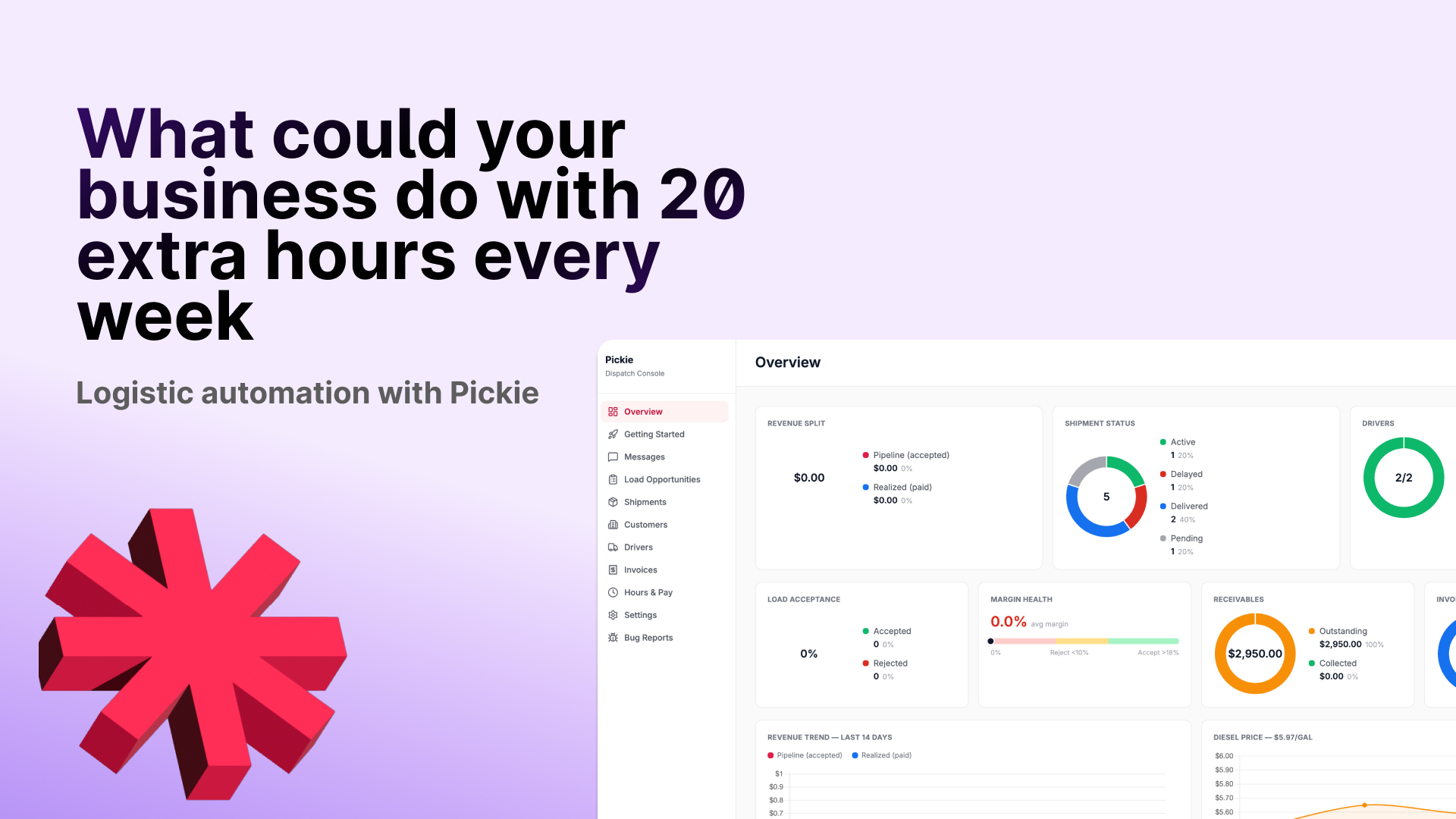




Imagine getting 20 hours back every week.
What would you do with them?
Would you spend that time finding new customers? Following up with leads that never received the attention they deserved? Building stronger relationships with your best clients? Taking on more work without immediately adding more administrative overhead?
Or perhaps you would simply finish the day without feeling like your business followed, you home.
For many growing businesses, those hours are not lost because people are not working hard enough. They are lost in the spaces between everything else; answering repetitive questions, chasing documents, updating spreadsheets, coordinating drivers, checking shipment statuses, moving information from one system to another.
This is where logistics automation becomes valuable, not as a way to automate a few tasks, but as a way to rethink how information moves through a business, how decisions get made and where employees spend their limited time. We value work-life balance but are we doing enough to achieve it?
Your Business is Not Short on Work, It is Short on Capacity
Growing a logistics business can look deceptively simple from the outside; more customers, more loads, more trucks, more drivers, more revenue.
However, every new customer and every additional load create more operational activity behind the scenes. Someone needs to receive the request, process the information, coordinate the driver, answer the customer’s questions, collect the proof of delivery, send the invoice and when something goes wrong, someone needs to step in.
At five loads, this is manageable. At fifty, the cracks begin to appear. At five hundred, the business can find itself spending an enormous amount of time simply keeping up.
 Top article todayExcel-to-App Evolution: Why the Transformation Matters for SME’s
Also Read: Agentic AI Vendors in Australia – Lead your Automation Transition
This is the operational ceiling many growing businesses eventually hit. Demand still exists, customers are still available, opportunities are still coming in but the business’s ability to process that demand is constrained by the people and processes holding everything together. The owner becomes the person everyone calls. The dispatcher becomes the person everyone messages. The operations team becomes the place where every problem eventually lands.
You would think a Transportation Management System (TMS) would solve this and for the core transportation process, it does. However, the operational work of a logistics company does not always happen inside the TMS. A broker sends a load request through WhatsApp. A dispatcher gets an email from a customer. A driver sends a photo of a proof of delivery through a messaging app. A manager tracks something in a spreadsheet because it is not in the company’s core systems.
The TMS manages the transportation process. The conversations, documents, decisions and follow-ups happening around that process remain fragmented. This is the opportunity for the next generation of logistics automation; not to replace the technology a business already relies on but to connect the work happening around it.

Meet Pickie: The Operational Layer for Modern Logistics
This is the distinction at the heart of Pickie. A TMS is a system of record. Pickie is an operational intelligence and action layer.
A load request arrives through WhatsApp. A customer asks for an update by email. A driver sends a document. A new lead needs following up. An invoice needs triggering. Instead of relying on someone to manually move information from one conversation to the next system, Pickie is designed to recognise the information, understand what needs to happen and trigger the appropriate workflow.
The result is not another isolated piece of software, it is a connected operational layer that works with the tools a business already uses; TMS, CRM, accounting platform, spreadsheets, email, WhatsApp and whatever else forms part of your daily operations.
“Keep the systems that already work. Automate the work that happens around them with Pickie”
At its core, the idea is straightforward; a person communicates, Pickie understands the information, the relevant data is captured, the right workflow is triggered, the right system is updated and when human judgement is genuinely required, the right person is notified.
The reason a business owner invests in that is not the technology itself. It is what happens on the other side; fewer repetitive calls, fewer manual follow-ups, faster responses, better visibility, more consistent processes, less time chasing information and more time growing the business.
 Read alsoConstruction Productivity in Australia: Build More Without Burning Out the People Who Build It
The Real ROI of Logistics Automation
When businesses think about automation, the first question is usually “how much money will this save me?” This is an important question but it is only part of the bigger picture. The real value shows up across four connected outcomes; money saved, time recovered, revenue opportunities captured and customer value created.
Take a hypothetical five-person operations team. Suppose each person spends an average of two hours a day on repetitive activities that could partially be automated; entering information, following up on documents, responding to routine enquiries and checking statuses. That roughly amounts to 10 hours a day or around 220 hours a month. At an effective cost of $30 an hour (for skilled labour), this is about $6,600 of labour capacity every month going toward that work.
This is not a promise that automation saves any business exactly $6,600 a month; the real number depends on the workflows, labour costs, systems and how much of the work can genuinely be automated. However, it illustrates something real, the cost of manual work is hidden inside payroll. It does not show up as a line item called “repetitive administration,” but the capacity is still being consumed.
The goal is not necessarily to replace the people doing this work, it is to free them, to spend more time on work that requires judgement, relationships and human attention. An owner who spends two hours answering routine shipment questions cannot spend those same two hours building customer relationships. A dispatcher chasing a missing POD cannot focus on the next load. This is operational leverage; not fewer hours worked but more valuable hours.
And efficiency and revenue are not separate things. A potential customer who emails after hours and does not hear back until the next morning may have already contacted three competitors; not because the business could not do the work, but because it did not respond fast enough. AI-powered automation can capture incoming enquiries, identify what is being requested, collect missing details, notify the right person and start the follow-up; without depending on someone remembering to check a message at exactly the right time. Every missed response is potentially a missed revenue opportunity.
Customers feel the difference too. Compare ‘Let me check and get back to you’ with ‘Your shipment is currently in transit and expected tomorrow, we will notify you of any change.’ The difference is not the automation itself but rather confidence. In logistics, customers do not just buy transportation, they most importantly buy certainty.

If you want concrete Australian examples of the operational ceiling — where demand keeps rising but growth stalls because the daily grind consumes capacity — read our piece on logistics automation in Australia for real situations and the symptoms owners report when their business hits that limit.
Get the best ones in your inbox — no spam, unsubscribe any time.
How Pickie Runs a Trucking Operation, Step by Step
A broker or dispatcher sends a shipment request through WhatsApp, with a container number and shipment details. Instead of someone manually copying that into another system, Pickie recognises the request, extracts the relevant information, identifies the shipper and records it in the right backend system.
From there, Pickie can pull in operational inputs like current diesel prices and run a profitability calculation, so the owner has a clear picture of a load’s economics before deciding, because a load opportunity does not wait for someone to spend 30 minutes gathering information from different places.
Also Read: Beyond the Hype – A Practical Guide to Optimising AI Expenses
Once a load is accepted, the workflow continues; driver communication coordinated through existing messaging channels, routine information distributed, driver requests captured, sick leave or emergencies escalated to the right person. The owner does not need to monitor every conversation; the system surfaces the ones that actually need a decision.
The same applies to customers; status requests get an accurate answer, exceptions get escalated, POD reminders go out automatically and completed documentation triggers the next step; invoicing, closing the loop.
Load intake, profitability assessment, driver coordination, shipment updates, document collection, invoicing, exception management; all connected. The owner is not removed from the business. The owner is removed from the repetitive parts of it, freeing them for the work only they can do; building relationships, finding new business and making strategic decisions.
Beyond Trucking – Where Else doe Pickie Apply
Trucking is where Pickie’s model is most obviously relevant but the underlying problem; information comes in, someone has to understand it, decide what happens next, take action, update a system and communicate with another person, shows up across almost every industry.
 Read alsoAgentic AI Vendors in Australia: Lead your Automation Transition
An e-commerce business fields ‘where is my order?’ hundreds of times a week. The work is expensive not because any one question is hard but because the same question gets answered over and over. An AI-powered workflow can identify the customer, retrieve the order, check delivery status and respond, the same principle extends to returns, refunds and product questions. The goal is not to remove human support; it is to make sure it is there when it is actually needed.
Last-mile delivery runs into the same pattern; delivery windows change, addresses change, deliveries fail, customers ask to reschedule; each one is another conversation between customer, driver and operations team. A connected automation layer coordinates those conversations, which means fewer unnecessary calls and better visibility across the delivery process.
Field services, wholesale distribution, property management and professional services all share the same shape; a customer request that needs to be qualified, assigned, confirmed, completed and invoiced, often across several disconnected systems. The industry changes but the operational pattern does not. This is where Pickie can contribute to your business.
AI & Automation Development in Australia: Why It Starts With the Business, Not the Tool
Australian businesses are increasingly exploring how AI and automation can be applied to their operations but there is an important difference between buying an AI tool and actually transforming how a business works. The first approach adds another piece of technology. The second starts with the business.
Also Read: Listen – AI is only a Tool, not your Strategy
For companies exploring AI & automation development in Australia, the real opportunity is not adding AI to a process because AI is popular, it is understanding how work actually moves through their organisation. Where does information enter? Where does it get lost? Which tasks repeat every day? Which conversations require someone to manually move information between systems? Where do customers experience delays? Where are leads being missed? Where does the owner still have to personally step in?
At FUZN, this is the approach we take to AI and automation; start with the operational reality of a business, then find where technology can remove friction, connect workflows and create additional capacity. Pickie is that philosophy in action; it started with a specific problem in logistics, too much valuable human attention consumed by repetitive work sitting between conversations, systems and people. The solution is not necessarily another piece of software. It is a smarter operational layer that helps the existing business work better.

See What Pickie Could Automate in Your Business
So, what could your business do with 20 extra hours every week? Maybe you would spend more time finding new customers, follow up with every promising lead, build stronger relationships with existing clients or handle more work without a matching rise in admin. Maybe your customers would get answers before they had to ask. Or maybe you would just have enough breathing room to think about where the business goes next.
Thais is exactly what operational automation should create, not more technology for its own sake, not another system your team has to learn, but more capacity to respond faster, serve customers better, nurture more opportunities and grow.
More Business. Less Busy. This is the idea Pickie is built around.
Every business has repetitive work hiding inside its operations; the question is how much of it still needs to be done by a human. If you want to explore where AI-powered automation could fit into your existing workflows, the Pickie team can show you what that could look like.