

Understand Structure Imperative: Why Structured Output is the Foundation of Enterprise AI Integration





In the evolution of AI integration, we’ve moved far beyond the “chat with your data” paradigm. Today’s enterprise AI systems need to do more than generate eloquent responses – they need to produce machine-readable, predictable, and actionable output that can seamlessly integrate with existing business systems, APIs, and workflows.
Yet most organizations are still wrestling with the fundamental challenge of structured output: how do you transform the beautiful chaos of natural language generation into the rigid precision that enterprise systems demand? The answer lies in understanding not just what structured output is, but why it is become the hidden bottleneck preventing many AI initiatives from scaling beyond proof-of-concept.
1. What is Structured Output in LLMs?
Structured output in Large Language Models refers to responses that conform to predefined, machine-readable formats rather than free-form natural language. Think of it as the difference between a human telling you “it’s pretty warm today, maybe around 75 degrees” versus a weather API returning {"temperature": 75, "unit": "fahrenheit", "condition": "warm"}.
The Anatomy of Structured Output
Format Specifications: The most common structured formats include:
- JSON (JavaScript Object Notation): The de facto standard for data exchange
- XML: Still prevalent in enterprise and government systems
- YAML: Human-readable data serialization, popular in configuration management
- CSV: Tabular data representation for analytics and reporting
- Protocol Buffers: High-performance serialization for microservices
Schema Enforcement: Modern structured output systems go beyond format – they enforce schemas that define:
- Required vs. optional fields
- Data types (strings, numbers, booleans, arrays)
- Value constraints (enums, ranges, patterns)
- Nested object relationships
- Validation rules
Recent Advances: Leading LLM providers have introduced sophisticated structured output capabilities:
- OpenAI’s Structured Outputs: Guarantees 100% schema compliance when
strict=true - Google’s Gemini: Native support for JSON Schema with constrained generation
- Anthropic’s Claude: Function calling with structured response formats
- Open-source tools: Outlines, Guidance, and JSONformer for self-hosted models
Beyond Simple JSON: Complex Structured Output
Consider this enterprise use case – a procurement system that needs to extract structured data from vendor proposals:
{
  "vendor_info": {
    "company_name": "TechSolutions Inc.",
    "contact_email": "[email protected]",
    "certification_status": "ISO_9001_CERTIFIED"
  },
  "proposal_details": {
    "line_items": [
      {
        "description": "Cloud Infrastructure Setup",
        "quantity": 1,
        "unit_price": 50000.00,
        "delivery_timeline": "6_WEEKS"
      }
    ],
    "total_cost": 50000.00,
    "payment_terms": "NET_30",
    "validity_period": "90_DAYS"
  },
  "compliance_flags": {
    "security_clearance_required": false,
    "regulatory_compliance": ["SOC2", "GDPR"],
    "risk_assessment": "LOW"
  }
}
This level of structured complexity enables automated vendor comparison, compliance checking, and integration with existing procurement workflows.
2. Why General Chat Output Fails in Integrated AI Systems
The fundamental mismatch between conversational AI and enterprise systems becomes clear when you consider what happens when a chat response like this hits your API:
 Top article todayExcel-to-App Evolution: Why the Transformation Matters for SME’s
Chat Response: “Based on the customer data, I’d recommend upgrading John Smith’s account to Premium. He’s been with us for about 3 years, his usage is consistently high around 85%, and he’s had some support tickets recently that suggest he’s hitting limits. The upgrade would cost around $200/month but would likely improve his experience significantly.”
What Your CRM API Expects:
{
  "customer_id": "string",
  "recommended_action": "upgrade|downgrade|maintain|cancel",
  "target_plan": "string",
  "confidence_score": "number",
  "reasoning_factors": ["array"],
  "estimated_revenue_impact": "number"
}
The Integration Chaos
Parsing Nightmares: Natural language responses require complex text processing pipelines:
- Regular expressions that break with slight wording changes
- Natural language processing to extract entities
- Ambiguity resolution for similar concepts
- Error handling for incomplete information
Reliability Issues: Research from recent benchmarks shows that traditional prompt engineering achieves only ~35.9% reliability for consistent formatting, while structured output approaches achieve near-100% reliability.
Scalability Bottlenecks: As AI systems scale, the computational overhead of parsing natural language becomes prohibitive:
- CPU-intensive text processing at high volume
- Complex validation logic for extracted data
- High error rates requiring human intervention
- Inconsistent output quality across different model versions
The “Format Drift” Problem
Even when chat interfaces work initially, they suffer from “format drift” – subtle changes in model behavior, prompt modifications, or input variations can completely break downstream systems. Consider this sequence:
Week 1 Output: “The customer satisfaction score is 8.5 out of 10” Week 2 Output: “Customer satisfaction: 8.5/10”
Week 3 Output: “Satisfaction score of 8.5 (scale: 1-10)” Week 4 Output: “Very satisfied (8.5)”
Each variation requires different parsing logic, making system maintenance nightmarish.
3. How AI Applications Generate Structured Value from Chaotic Text
The transformation from unpredictable natural language to structured data requires sophisticated orchestration systems that combine multiple approaches:
Constrained Generation Techniques
Finite State Machines (FSM): Modern structured output systems use FSMs to guide token generation:
 Read alsoStrait of Hormuz Chokehold Warning Lessons for Australian Businesses!
- Each token must advance the FSM to a valid state
- Invalid tokens are masked with zero probability
- Guarantees syntactic correctness but can impact semantic quality
Grammar-Guided Generation: Tools like Outlines and XGrammar enforce formal grammars:
from outlines import models, generate

# Define the model and schema
model = models.transformers("microsoft/DialoGPT-medium")
schema = {
    "type": "object",
    "properties": {
        "customer_id": {"type": "string"},
        "risk_score": {"type": "number", "minimum": 0, "maximum": 100},
        "recommendation": {"type": "string", "enum": ["approve", "deny", "review"]}
    },
    "required": ["customer_id", "risk_score", "recommendation"]
}

# Guaranteed valid JSON output
generator = generate.json(model, schema)
result = generator("Analyze customer creditworthiness...")
Multi-Stage Processing Pipelines
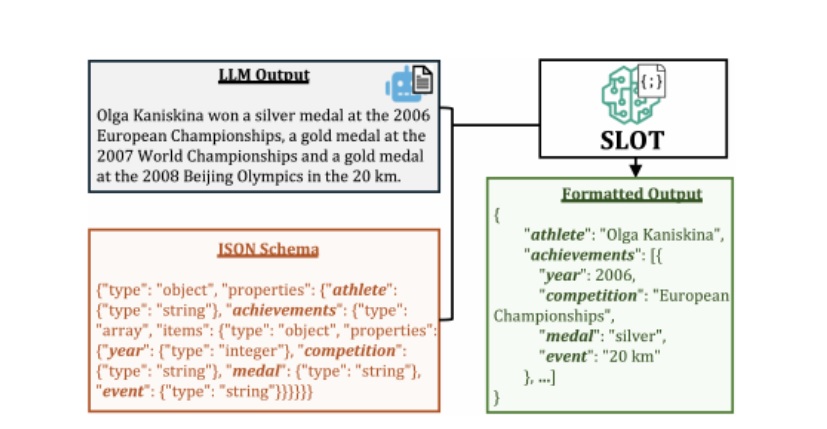
The SLOT Architecture: Recent research has introduced SLOT (Structured LLM Output Transformer), which uses a two-stage approach:
- Base Generation: Standard LLM generates rich, detailed responses
- Structure Extraction: Specialized lightweight model transforms output to structured format
This achieves 99.5% schema accuracy while maintaining 94.0% content similarity – outperforming even Claude-3.5-Sonnet by significant margins.
Hybrid Validation Systems: Enterprise implementations often combine multiple validation layers:
class StructuredOutputValidator:
    def __init__(self):
        self.syntax_validator = JSONSchemaValidator()
        self.semantic_validator = SemanticConsistencyChecker()
        self.business_validator = BusinessRuleEngine()

    def validate_and_repair(self, llm_output, schema, context):
        # Stage 1: Syntax validation and repair
        try:
            parsed_output = self.syntax_validator.validate(llm_output, schema)
        except ValidationError:
            parsed_output = self.repair_json(llm_output, schema)

        # Stage 2: Semantic consistency
        semantic_score = self.semantic_validator.check(parsed_output, context)
        if semantic_score < 0.8:
            parsed_output = self.semantic_repair(parsed_output, context)

        # Stage 3: Business rule validation
        business_violations = self.business_validator.check(parsed_output)
        if business_violations:
            parsed_output = self.apply_business_fixes(parsed_output, business_violations)

        return parsed_output
Schema Reinforcement Learning
Recent advances in Schema Reinforcement Learning (SRL) show dramatic improvements in structured generation:
- Fine-grained Schema Validators: Provide detailed feedback on schema violations
- Thought of Structure (ToS): Encourages models to reason about structure before generation
- Online Learning: Continuously improves based on validation feedback
Research shows SRL achieves up to 40% improvement in valid complex JSON generation compared to supervised fine-tuning alone.
4. The Enterprise Imperative for Structured Output
Integration Architecture Requirements
Enterprise AI systems operate within complex architectural constraints that demand structured output:
API-First Design: Modern enterprise architectures are built around APIs that expect specific data contracts:
Get the best ones in your inbox — no spam, unsubscribe any time.
- RESTful services with OpenAPI specifications
- GraphQL schemas with type safety
- Message queue systems requiring structured payloads
- Database integration with schema validation
Compliance and Audit Requirements: Regulated industries need:
- Traceability: Structured output enables audit trails
- Reproducibility: Schema enforcement ensures consistent results
- Governance: Structured data supports policy enforcement
- Risk Management: Predictable output formats reduce operational risk
Real-World Enterprise Use Cases
Financial Services: Credit Risk Assessment
{
  "application_id": "CR-2025-001234",
  "risk_assessment": {
    "credit_score_impact": {
      "current_score": 742,
      "projected_score": 755,
      "confidence_interval": [745, 765]
    },
    "risk_factors": [
      {
        "factor": "payment_history",
        "weight": 0.35,
        "score": 0.92,
        "trend": "improving"
      }
    ],
    "recommendation": {
      "decision": "APPROVED",
      "credit_limit": 50000,
      "interest_rate": 0.129,
      "conditions": ["automatic_payment_setup"]
    }
  },
  "regulatory_compliance": {
    "fair_lending_check": "PASSED",
    "adverse_action_code": null,
    "explainability_score": 0.87
  }
}
Healthcare: Clinical Decision Support
{
  "patient_id": "PT-789012",
  "clinical_assessment": {
    "symptoms": [
      {
        "symptom": "chest_pain",
        "severity": "moderate",
        "duration_hours": 6,
        "characteristics": ["sharp", "intermittent"]
      }
    ],
    "differential_diagnosis": [
      {
        "condition": "angina_pectoris",
        "probability": 0.73,
        "urgency": "moderate",
        "recommended_tests": ["ECG", "troponin_levels"]
      }
    ]
  },
  "treatment_recommendations": {
    "immediate_actions": ["nitroglycerin_sublingual"],
    "monitoring_required": ["cardiac_enzymes_q6h"],
    "specialist_referral": "cardiology_urgent"
  }
}
Cost and Efficiency Impacts
Processing Efficiency: Structured output eliminates expensive post-processing:
- Before: 200ms LLM inference + 50ms text processing + 30ms validation
- After: 220ms structured LLM inference (total)
- Result: 27% faster end-to-end processing
Error Reduction: Schema validation catches errors before they propagate:
- Manual intervention reduced from 15% to <1% of cases
- Data quality scores improved from 78% to 97%
- Customer-facing errors reduced by 85%
Development Velocity: Type-safe structured output accelerates development:
- Automatic code generation from schemas
- IDE support with autocomplete and validation
- Simplified testing with predictable data structures
5. Best Practices for Generating Structured Output in LLMs
Schema Design Principles
Start Simple, Scale Complex: Begin with flat structures and add nesting gradually:
# Start here
class SimpleOrder(BaseModel):
    order_id: str
    customer_id: str
    total_amount: float
    status: OrderStatus

# Evolve to this
class ComplexOrder(BaseModel):
    order_id: str
    customer: CustomerInfo
    line_items: List[LineItem]
    pricing: PricingDetails
    fulfillment: FulfillmentInfo
    metadata: OrderMetadata
Use Enums for Controlled Vocabularies: Prevent “creative interpretation” by LLMs:
class OrderStatus(str, Enum):
    PENDING = "pending"
    CONFIRMED = "confirmed"
    SHIPPED = "shipped"
    DELIVERED = "delivered"
    CANCELLED = "cancelled"

    @classmethod
    def _missing_(cls, value):
        # Handle common LLM variations
        normalized = value.lower().replace(' ', '_')
        for member in cls:
            if member.value == normalized:
                return member
        return cls.PENDING  # Safe default
Include Explanation Fields: Give LLMs space to reason:
 Read alsoWhy Most Australian SMEs Use Only 20% of What They Are Paying For Zoho CRM
class RiskAssessment(BaseModel):
    risk_score: float = Field(ge=0, le=100)
    risk_level: RiskLevel
    explanation: str = Field(
        description="Detailed explanation of risk factors and scoring rationale"
    )
    contributing_factors: List[str]
Prompt Engineering for Structured Output
The Schema-in-Prompt Pattern:
def create_structured_prompt(schema: Dict, user_input: str) -> str:
    return f"""
You are a data extraction specialist. Extract information from the following text
and format it according to the JSON schema provided.

INPUT TEXT:
{user_input}

REQUIRED JSON SCHEMA:
{json.dumps(schema, indent=2)}

INSTRUCTIONS:
1. Extract ALL available information that matches the schema
2. Use null for missing optional fields
3. Ensure all enum values match exactly
4. Provide detailed explanations in explanation fields
5. Return ONLY valid JSON - no additional text

JSON OUTPUT:
"""
Temperature and Sampling Strategy:
- Structured tasks: temperature=0.1-0.3 for consistency
- Creative structured tasks: temperature=0.5-0.7 with schema validation
- Use top_p=0.9 to maintain quality while allowing some creativity
Validation and Error Recovery
Multi-Layer Validation Strategy:
class StructuredOutputPipeline:
    def __init__(self):
        self.validators = [
            SyntaxValidator(),
            SchemaValidator(),
            BusinessRuleValidator(),
            SemanticConsistencyValidator()
        ]
        self.repair_strategies = [
            JSONRepair(),
            ValueNormalization(),
            DefaultValueInjection(),
            LLMBasedRepair()
        ]

    def process(self, llm_output: str, schema: Dict) -> Dict:
        for attempt in range(3):  # Retry logic
            try:
                # Validate through all layers
                for validator in self.validators:
                    llm_output = validator.validate_and_repair(llm_output, schema)
                return json.loads(llm_output)
            except ValidationError as e:
                # Apply repair strategies
                llm_output = self.apply_repair_strategies(llm_output, e, schema)

        raise StructuredOutputError("Failed to produce valid output after 3 attempts")
Graceful Degradation Patterns:
class FallbackStructuredOutput:
    def generate(self, prompt: str, schema: Dict) -> Dict:
        try:
            # Primary: Native structured output
            return self.primary_llm.generate_structured(prompt, schema)
        except StructuredOutputError:
            try:
                # Secondary: Prompt engineering + validation
                return self.secondary_llm.generate_with_schema_prompt(prompt, schema)
            except Exception:
                # Tertiary: Best-effort extraction with human review flag
                result = self.extract_partial_structure(prompt, schema)
                result["_requires_human_review"] = True
                return result
Performance Optimization
Schema Caching: Pre-compile schemas for repeated use:
@lru_cache(maxsize=1000)
def get_compiled_schema(schema_hash: str) -> CompiledSchema:
    schema = load_schema_by_hash(schema_hash)
    return compile_schema(schema)
Batch Processing: Process multiple structured requests together:
def batch_structured_generation(prompts: List[str], schema: Dict) -> List[Dict]:
    # Combine prompts with separators
    batch_prompt = create_batch_prompt(prompts, schema)

    # Single LLM call for multiple outputs
    batch_response = llm.generate(batch_prompt)

    # Parse individual responses
    return parse_batch_response(batch_response, schema)
Model Selection Strategy:
- GPT-4o-mini: Excellent structured output performance at low cost
- Claude-3.5-Sonnet: Best for complex reasoning with structure
- Local models with Outlines: Maximum control and privacy
- Mixture of Experts: Route based on complexity
Testing and Quality Assurance
Schema Evolution Testing:
def test_schema_backward_compatibility():
    old_outputs = load_historical_outputs()
    new_schema = load_current_schema()

    for output in old_outputs:
        assert validate_against_schema(output, new_schema, allow_missing=True)
Stress Testing with Edge Cases:
edge_cases = [
    "empty_input",
    "malformed_input",
    "unicode_edge_cases",
    "extremely_long_input",
    "conflicting_information",
    "ambiguous_references"
]

for case in edge_cases:
    test_input = load_test_case(case)
    result = structured_generator.generate(test_input, schema)
    assert_valid_schema(result, schema)
    assert_semantic_quality(result, test_input)
Building the Future of Structured AI
Structured output is not just a technical requirement – it is the foundation that enables AI systems to move from impressive demos to mission-critical enterprise applications. As we look ahead, several trends will shape the evolution of structured output:
Native Model Support: Future LLMs will have structured output as a first-class feature, not an afterthought Dynamic Schema Generation: AI systems that can generate and evolve their own schemas based on business requirements Cross-Modal Structured Output: Extending structured generation beyond text to images, audio, and video Real-Time Schema Validation: Streaming validation that corrects structure during generation
The organizations that master structured output today will be the ones that successfully scale AI beyond the proof-of-concept phase. They will build AI systems that do not just chat intelligently – they integrate seamlessly, operate reliably, and deliver measurable business value.
The question is not whether your AI can understand language – it is whether it can speak the language of your business systems. If you are need more guidance on the domain, reach out to us so we can guide you better.