






Off-the-shelf business tools like HubSpot, Salesforce and Zoho served their time. They offered standardized workflows for sales, marketing and customer management until now but in doing so, they forced teams to mold themselves around rigid architectures. Today, these general-purpose platforms often create more friction than they solve. They are overloaded with features, under-optimized for specific industries and costly to customize. As businesses become more specialized, the demand for contextual, efficient and scalable tools has surged. The solution? Custom Micro-SaaS applications.
Until recently, building custom CRMs or operational tools meant high development costs, long implementation cycles and significant trial-and-error. But this was before the rise of generative AI. Tools powered by large language models (LLMs) like GPT-4, Claude 3 Sonnet to name a few, have transformed how software is ideated, built, tested and maintained, since the past few years. For the first time, teams can go from concept to working prototype in days, not months and with drastically reduced engineering overhead. Isn’t that amazing?
Also Read: Why the Excel-to-App Revolution Matters for SMEs
Why Now? The Micro-SaaS Era is here, and AI is the Catalyst
The timing is no coincidence. Over the last 18 months, AI tooling has matured significantly, moving from novelty to core utility. Businesses are embracing Micro-SaaS platforms: compact, focused applications designed for specific workflows or departments. Unlike legacy SaaS systems that attempt to be everything to everyone, Micro-SaaS applications deliver high impact for targeted use cases.
 Top article todayExcel-to-App Evolution: Why the Transformation Matters for SME’s
AI has accelerated this shift by reducing traditional bottlenecks in software development. From autocompleting code to generating documentation, suggesting database schemas and even mocking UI components, generative AI enables lean teams to build robust software faster. The result is a development lifecycle that is shorter, smarter and far more agile.
Cost and Complexity are no longer Gatekeepers
What once required a $100K+ development budget and months of engineering can now be achieved in a few weeks, at a fraction of the cost. AI enables this reduction not only through automation but also by minimizing the need for deep specialization at every stage of development. Builders can now prototype, validate and iterate quickly, often with smaller cross-functional teams.
Beyond cost, the strategic benefit lies in flexibility. With custom Micro-SaaS tools, organizations no longer must work around someone else’s roadmap or wait for features they critically need. Instead, they can architect internal systems to match their unique workflows and data models; achieving better productivity, stronger data ownership and clearer visibility across teams.
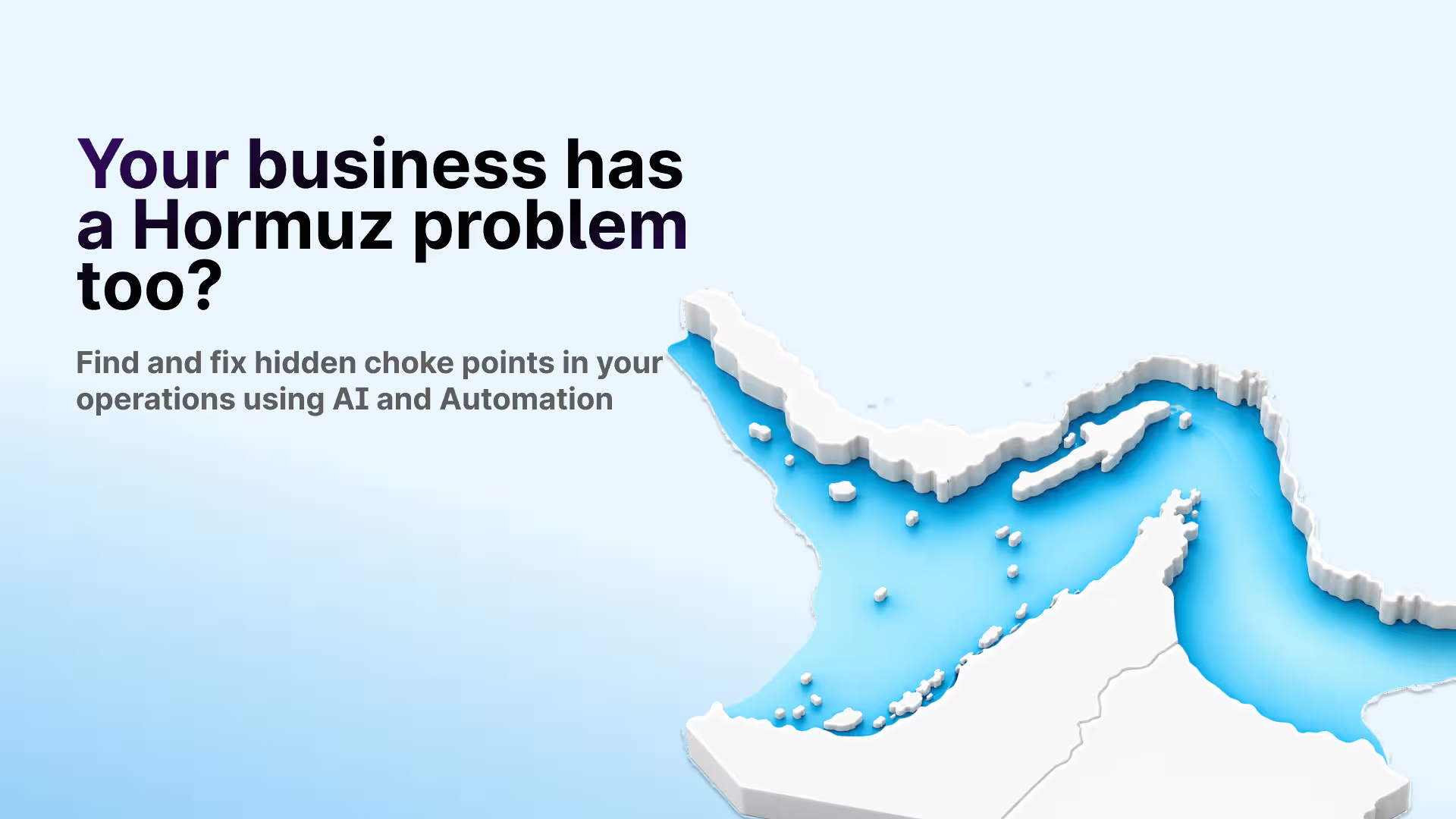 Read alsoStrait of Hormuz Chokehold Warning Lessons for Australian Businesses!
Where No-Code Meets Pro-Code: Case Study from Ramp
Today’s software development environment thrives at the intersection of no-code and pro-code. Tools like Retool, Bubble and Appsmith allow product and operations teams to quickly launch usable applications. Meanwhile, developers can plug in custom code where necessary, creating a hybrid environment that moves fast without compromising on complexity or scale.
A strong example of this approach is Ramp, the corporate card and finance automation company. To keep up with their rapid growth, Ramp chose to build a number of their internal tools using Retool, supercharged by custom scripts and AI integration. These tools handled everything from employee onboarding to support ticket resolution saving engineering time, reducing third-party dependencies and enabling faster ops cycles. They did not wait for a vendor to build what they needed. They built it themselves and it worked.
From Trial-and-Error to Right First-Time: FUZN’s Approach
Perhaps the most transformative impact of AI in this space is the collapse of the trial-and-error loop. With AI-enabled development, feedback loops are shorter and smarter. Developers can validate logic instantly, simulate outcomes and auto-generate alternate implementations in seconds. This minimizes downtime, reduces the risk of technical debt and dramatically increases delivery velocity.
Get the best ones in your inbox — no spam, unsubscribe any time.
At FUZN, we are actively helping organizations leverage this shift. Our team works with companies to design and build custom CRMs, dashboards and business tools using a combination of AI-first architecture, rapid prototyping and lean iteration cycles. We do not retrofit existing SaaS products, we build domain-specific solutions that fit your business out of the box. Whether you are replacing an overbuilt CRM or automating internal workflows, our model reduces implementation timelines from months to weeks with measurable impact from day one.
The Future Is Contextual, AI-Native and Yours to Build
In a world where business needs to evolve faster than SaaS roadmaps, the move toward custom Micro-SaaS is not just a trend it is a strategic necessity. The barriers of cost, complexity and risk have been torn down by generative AI and modular developer tools.
Companies no longer need to adapt to the limitations of off-the-shelf software. Instead, they can implement intelligent systems tailored to their own workflows, logic and objectives. From CRM’s to customer success tools to back-office automation, if it powers your operations, it can now be custom-built; faster and smarter than ever before.
 Read alsoWhy Most Australian SMEs Use Only 20% of What They Are Paying For Zoho CRM
The question is not whether custom Micro-SaaS is viable. It is whether your business is ready to lead or get left behind. Ready to architect your own high impact Micro‑SaaS?
Let us put AI to work for you, drop us a line and let’s get started.