AI Financial Reconciliation: How a Lunch Conversation Uncovered AUD $50,000 in UnInvoiced Sales





Two friends were having lunch over a busy Sydney cafe, work was not on the menu and neither expected the conversation to lead anywhere near a finance team. Then one of them mentioned, in passing, how hard it had become to keep track of his growing business in his Excel spreadsheets. It had become so unmanageable that every time he opened it, he would get frustrated.
What follows is a story about AI financial reconciliation that every Australian business owner can learn from. It starts with Lobuche, a wholesale distributor of leather goods supplying retailers across Australia and Japan, three financial years of sales spread across Excel workbooks and a HubSpot CRM, and a business owner who had simply outgrown the way he tracked it all. Nothing about the growing Lobuche business looked broken and this is exactly what makes it so interesting.
A Lunch, a Laptop and a Healthy Dose of Scepticism
One of FUZN’s founders was having lunch with a friend who happens to run Lobuche. It was a catch-up between friends, not a business meeting and the conversation covered everything except work and AI. Then, almost out of context, the owner mentioned how frustrating it had become to keep track of the business as it grew. Sales relationships lived in HubSpot. The financial records lived in a Master Excel Sheet for each financial year and every year the files got heavier, the tabs multiplied and the data got harder to track.
Our founder put down his fork. He had spent enough time around growing businesses to recognise that tone, the weary one that says a system has quietly outgrown the person running it. He asked a single question; if something had slipped through the cracks, how would he know?
The owner laughed, then admitted that he would not. It was a candid answer and it turned a casual lunch into a different kind of conversation. When our founder wondered aloud whether AI could help make sense of it all, the reaction was polite and sceptical, and the Lobuche owner is happy to say so.
“I had gone to lunch to catch up with a friend and the spreadsheet frustration just slipped out. When AI came up, my first reaction was of scepticism. Everyone is currently selling AI at the moment and I have been burned before by software that promised to fix my admin and simply gave me more of it. The spreadsheets, however, really had become unmanageable and I thought if someone wanted to take a look with no strings attached, the worst case was a few hours of my afternoon spent with a friend.” – Owner, Lobuche
What followed next was an invitation by our founder to an informal, no-commitment session at the FUZN office, whenever his friend could spare time. The very next afternoon he arrived with his laptop, visibly unsure of what he had agreed to. He walked our team through how the Lobuche business actually ran, which workbooks mattered, what HubSpot was used for and which questions he had never been able to answer with certainty. Our tech team listened quietly as the only task at that stage was to understand the business. This is what we normally do during any of our discovery call.
 Top article todayExcel-to-App Evolution: Why the Transformation Matters for SME’s
Inside the Lobuche Master Sheets
After the initial briefing, he hesitantly, shared access to Lobuche’s master spreadsheet to our tech team. If you have ever inherited a business spreadsheet, you will recognise what we found. Each financial year had its own Master workbook, covering 2023-24, 2024-25, 2025-26 and an ongoing 2026-27. Inside each one sat a tab for every month of Australian wholesale orders, a separate tab for Japan, a running list of invoice numbers and a summary sheet that had been rebuilt more than once.
Over three years, the structure had drifted, as it does in any busy business. Columns had been added part-way through a year when a new requirement appeared. Japanese orders were recorded in yen alongside a converted Australian dollar figure, using whatever exchange rate was current on the day. Dates followed different formats depending on who had entered them. One Melbourne boutique retailer appeared under three slightly different spellings. Invoice numbers were sometimes stored as numbers and sometimes as text, with and without prefixes. Rows were shaded green when invoiced and yellow when pending, but the colours had never been formally defined, so they meant slightly different things to different people. Scattered through the note’s columns were reminders such as “inv to follow” and “waiting on freight”, each one a human memory commitment to come back later.
Meanwhile, HubSpot told a parallel story. The sales team logged deals, moved them through stages and marked them Closed Won when a customer committed. In principle, a Closed Won deal should eventually become a line in the Master Sheet and then an invoice. In practice, that handover depended on someone remembering to carry the information from one system to the other.
None of this reflected carelessness. Lobuche’s finance team worked diligently with the tools they had. The real issue was rather structural; the sales record and the financial record were two separate stories and the only thing connecting them was human memory; primarily the owner.
Twenty Minutes, One Quiet Room, One Surprising List
The owner sat with his arms folded but visibly unconvinced, while our tech team connected his HubSpot export to the three Master workbooks and set our internal AI system running. They had asked for twenty minutes. He had agreed to stay for twenty minutes, mostly out of curiosity about what could possibly come back.
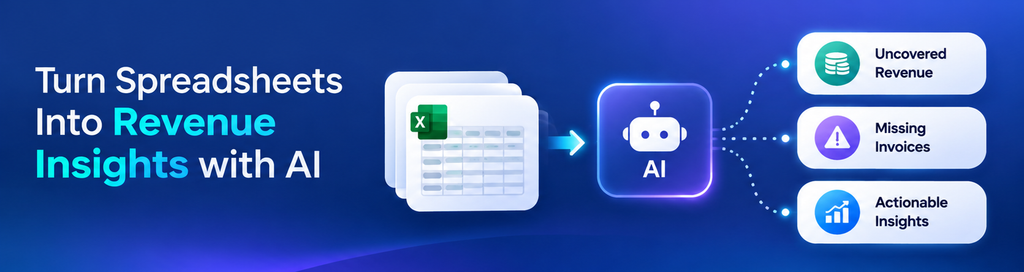
For the first few minutes, nothing happened that he could see. Lines of progress scrolled past as the system tidied up customer names, untangled date formats and matched invoice numbers across three years of files. Then the screen filled with a list. Each row held a transaction, a date, a customer and a plain-language reason it had been flagged, such as a Closed Won deal with no invoice number or a second shipment with no bill.
The owner slowly unfolded his arms. He leaned toward the screen and began reading customer names aloud, recognising each one before he had read the amount beside it. Then the total at the bottom came up; approximately AUD $50,000, across transactions dating back to early 2024. Nobody in the room said anything for a moment. The owner asked the question everyone was thinking; could that possibly be right?
It was however, the right question to ask. The generated list was not a verdict, only a set of flagged leads by our system and every raised flagged still needed to be checked or verified by Lobuche’s finance team; the people who knew the financial dynamics of the business best. This illustrates an important question, how much of revenue can still go quietly missing in a business that is run well?
 Read alsoTool-Call Reliability in Production LLM Agents
Where the AUD $50,000 Was Hiding
As the owner and our team worked down the flagged list together, what stood out was how ordinary it all was. There was no single dramatic failure, only four everyday gaps, each understandable on its own and costly in combination. The figures below are rounded but they show how the total built up.
Split shipments and backorders (around AUD $17,000)
In leather wholesaling, stock rarely moves in a single clean batch. A retailer might order several hundred belts and wallets, only for one popular colourway to be out of stock until the next production run. The first shipment would go out and be invoiced against the original order, and the row would turn green. When the balance shipped three or four weeks later, the order already looked complete. The second batch of products have had been delivered but never billed.
Japanese sample sets that quietly became orders (around AUD $14,000)
Japanese buyers often trialed a range before committing to a seasonal order, so sample sets were sent on trial terms and logged as no-charge. When a buyer liked what they saw, the confirmation often arrived as a short email reply rather than a formal purchase order. The sales team would move the HubSpot deal to Closed Won but because there was no new purchase order, the finance sheet still carried the original “sample, no charge” note. The calendars made it harder still. Japan’s financial year ends in March and Australia’s in June, so orders placed ahead of a Japanese year-end sat awkwardly across two different reporting rhythms.
Freight, duty and customisation recharges (around AUD $9,000)
Some costs were agreed with customers but billed separately from the base order. Expedited air freight, handling on Japanese consignments, embossing or monogramming on private-label runs; each of which was discussed, accepted and delivered, then noted in a comment cell with the intention of adding it to a later invoice. Many of those later invoices never carried the extra charge.
Repeat orders placed by phone and message (around AUD $10,000)
Long-standing Australian retailers do not always use the order form. A quick call or message to their regular contact is often enough. Lobuche’s sales rep would log the deal in HubSpot, the warehouse would pack the order and the goods would leave as usual. However, since the order never passed through the usual intake process, it never received its own row in the monthly tab and so it never reached an invoice.
Get the best ones in your inbox — no spam, unsubscribe any time.
As each flagged list details came up, the owner could reflect back on his memory. A retailer he had spoken to on the phone, a Japanese buyer he had flown to meet, a freight surcharge he remembered agreeing to over a quick call. He went quiet for a moment, then laughed. In every case, the sale was real, the stock had shipped and the information existed somewhere inside the business. It had simply never been connected.
How AI Financial Reconciliation Found What Manual Review Missed
This is where the technology earned its place. Instead of reading each spreadsheet line in isolation, our internal system examined HubSpot deals, delivered orders and invoice references across all three workbooks together. It standardised the inconsistent customer names, dates, currencies and invoice formats, then looked for transactions that had no matching invoice. Each flagged item was ranked by value and age, with a plain-language reason attached, such as a Closed Won deal with no invoice number or a second shipment with no corresponding bill.
A careful person comparing the same records by hand could easily spend weeks and still miss items, because the gaps only appear when several files and a CRM are read side by side. The system needed about twenty minutes.
The system did not decide anything about what Lobuche was owed. It produced a list of potential discrepancies and Lobuche’s finance team verified them. A handful turned out to have legitimate explanations and were set aside. The rest were confirmed and the transactions were invoiced.
It is worth being precise about the outcome. The AUD $50,000 represents transactions that were identified and then invoiced after finance verification. It is not cash already collected or a guaranteed recovery.
“What got me was not the number. It was that every one of those sales was already in my own files. I had paid for the stock, shipped it and chased the freight, and I never closed the loop on the last step. My team did not miss it because they are careless. Nobody can hold three years of spreadsheets in their head. I am still sceptical about plenty of the AI hype but this was a tool doing a job I could not do and then handing the decision back to us.” – Owner, Lobuche
Excel Is Not the Villain: Why Manual Analysis Leaks Information
It would be easy to read this story as a case against spreadsheets. We think that is the wrong lesson. Excel is flexible, familiar and fast, which is exactly why a growing business like Lobuche built its operations around it. Few tools handle a changing business so forgivingly.
The weakness lies in how the information is analysed. When people reconcile records by hand, every check depends on attention, memory and time. Three workbooks open side by side, a CRM in another tab and a looming month-end close are the perfect conditions for small gaps to slip through. Each handover between systems is a place where information can leak and the more a business grows, the more handovers there are.
 Read alsoStrait of Hormuz Chokehold Warning Lessons for Australian Businesses!
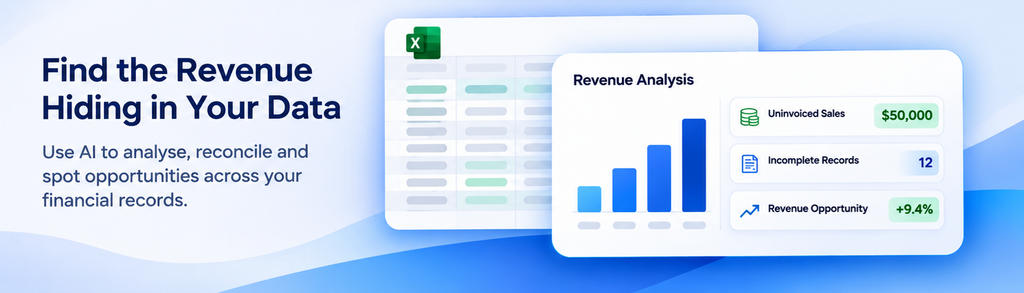
This is where Excel automation makes a practical difference. It does not mean abandoning the spreadsheets your team knows. It means adding an automated layer that reads them, cross-checks them against your CRM and flags what does not line up, so people spend their time on judgement rather than scanning rows.
The wider data supports the idea that manual processes are a common pressure point. OFX research conducted by Ipsos in October 2025 surveyed more than 500 Australian SME accountants and finance decision-makers and found that 80% of SMEs still relied on manual processes for expenses, while 94% of respondents reported tangible benefits from automation, including faster reconciliations and better accuracy. Meanwhile, a Gartner survey of 121 finance leaders reported that 58% of finance functions were using AI in 2024, up from 37% the year before, with anomaly and error detection among the leading use cases. This AI adoption has yet to reach the majority of the business owners, who could tremendously benefit from it; only if they could act on their hesitations.
Financial Automation Australia: From a One-Off Check to an Everyday Habit
A single diagnostic can recover missed revenue but the greater value comes from making the check routine. With the right integrations, the same reconciliation can run on a regular schedule, so that a split shipment, an unbilled recharge or a Closed Won deal without an invoice is flagged within days rather than discovered years later. For Australian businesses managing multiple systems, currencies or markets, this kind of financial automation Australia teams can rely on is becoming a practical part of staying in control rather than a luxury.
The pattern is not unique to wholesale. Construction firms can lose track of variations and milestone claims. Professional services businesses can miss billable hours when project records and billing run separately. Logistics operators can overlook additional charges on completed deliveries. The common thread is not a shortage of information. It is the difficulty of connecting it.
At FUZN, our principle is simple; automate the friction, amplify the human. Lobuche’s finance team stayed in charge of every decision. The AI simply gave them a clearer view of what their own records were saying.
Does Your Business Have a Visibility Problem?
Not every financial opportunity requires more customers, more marketing or a new sales strategy. Sometimes it is sitting inside the business, waiting to be found. If your CRM shows deals marked as won that you cannot trace to an invoice, if notes like “invoice to follow” have been sitting in your spreadsheets for months or if your team spends days comparing records every month-end, it may be worth asking how confident you really are that your systems are telling the same story.
At FUZN, we start by understanding how your business operates, where your information lives and where the friction sits. From there, we identify practical ways AI financial reconciliation, Excel automation and connected systems can give you a clearer, more reliable view of your numbers.
Your next growth opportunity might already be in your data. You just need a better way to find it.
If you would like to see what your existing records within business Excel worksheets, Google sheets or any other accounting ledgers could reveal, talk to FUZN