



Running a trucking business with three trucks is one thing. Running the same business with fifteen is something else entirely. The drivers, customers and loads all multiply but the owner’s day does not and somewhere along the way the work of keeping everything moving starts to crowd out the work of growing the business.
You probably recognise the morning routines. One driver is waiting on delivery instructions, another is running behind, a customer wants to know where their freight is and a new load offer needs a price before someone else wins it. Each task is small yet critical to the business. Together these tasks fill the day and the owner or dispatcher who should be finding the next profitable load ends up answering the same questions over and over.
Larger operators solve this with transport management systems (TMS) and dedicated dispatch teams, which is a sensible answer when you can spare the time and money to put them in place. Many small fleets cannot and small fleets comprise most of the industry; the American Trucking Associations reports that 91.5% of US carriers operate ten or fewer trucks.
This is the problem we built Pickie to solve. Pickie also works over WhatsApp, the app your drivers and customers already use. It checks in with drivers, answers customer questions, prices load offers and drafts invoices, while your team stays in control of the decisions that matter. It is designed for carriers with one to fifty trucks and each setup during the onboarding is built around how your business already works.
Try Pickie yourself with a free 72-hour trial
Why we decided to build Pickie
At FUZN, we made an internal commitment to look beyond the industries already drawing most of the AI investment. The excitement around artificial intelligence has centered on sectors with large technology budgets and obvious commercial prizes, and we believed there was just as much value in overlooked businesses where practical automation could make a difference straight away. Not every useful AI product needs to transform an industry. Sometimes the best outcome is a business owner getting a few hours of the working day back.
 Top article todayExcel-to-App Evolution: Why the Transformation Matters for SME’s
The idea for Pickie came out of a conversation with a colleague who had worked in the US logistics industry. He described smaller trucking operations where owners handle dispatch themselves, drivers needing constant follow-up, customers expecting immediate answers and profitable freight competing for attention with routine admin personnel. What primarily stood out was that these legacy businesses were not short of technology. So much of the day, however, still depended on one person coordinating every moving part.
This raised a question we could not ignore at FUZN; what if a small transport business could have the operational support usually reserved for a much larger one, without building an IT department to get it? This very question became Pickie and we wanted it to be useful enough that an owner would recognise its value in their own working day, rather than simply admiring the technology behind it. Automation should be about tangible impact not the hype surrounding AI.
The operational challenge nobody foresees until the fleet starts growing
Most trucking companies do not begin with complicated processes and they do not need to. With a handful of trucks, the owner knows the drivers, remembers which loads are moving and carries every customer’s requirements in their head. This informal system is fast, flexible and cheap, which is exactly why it lasts as long as it does. Why change what works right? The trouble is that it runs on one person’s attention and attention cognition does not grow with the fleet.
As the company grows, the cost shows up in what does not happen rather than in what does. An enquiry gets priced late or in a hurry. The better-paying load never gets chased because the morning went on confirming deliveries already underway. The owner finishes the week exhausted and busy, yet no closer to the freight that would move the business forward.
The obvious fixes are to hire another dispatcher or invest in a traditional TMS and both can be the right call. A well-implemented TMS coordinates jobs, manages operational data and gives a larger business the structure it needs. However, not every small fleet is ready for that commitment of money, training and change. Some just need an easier first step; a way to take repetitive work off the day and make coordination more manageable without a major implementation. This is the gap Pickie fills.
Meet Pickie, your dispatch assistant on WhatsApp
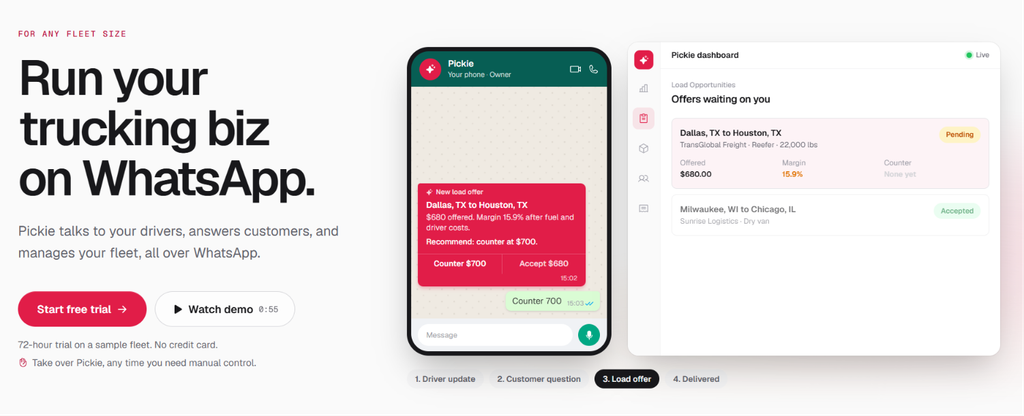
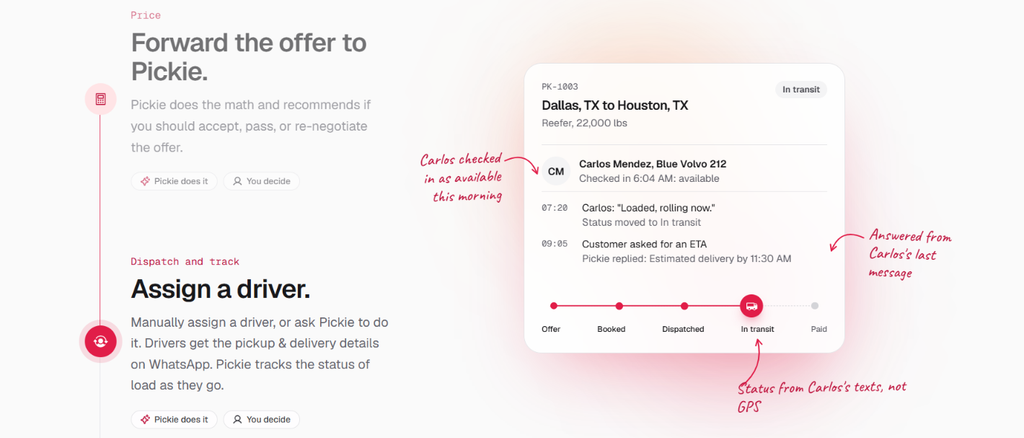
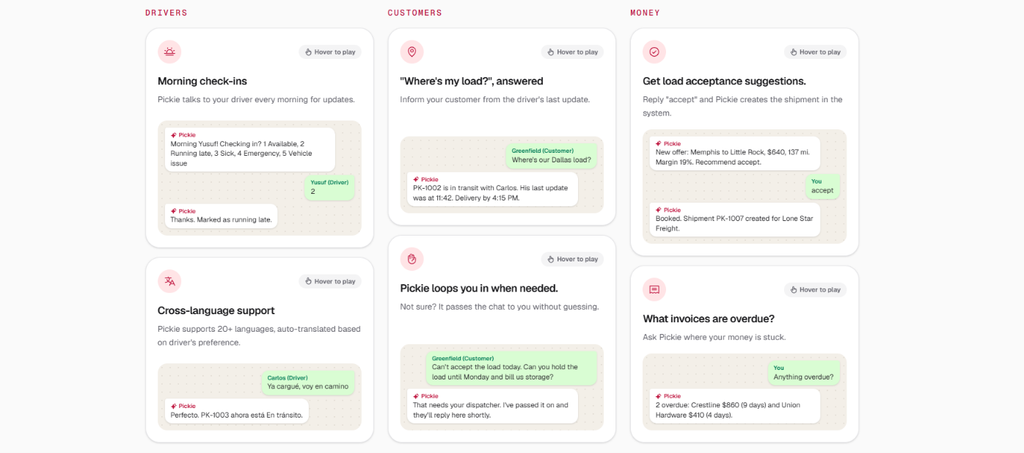
Pickie takes on the routine conversations that fill a dispatcher’s day. It checks in with drivers to find out where jobs stand, answers customers questions about their freight, sends Proof-of-Delivery (POD), prices load offers so you can decide quickly whether a job is worth taking and drafts the invoices that follow. All of it happens over WhatsApp and a dashboard shows each shipment’s full delivery journey so your team can see what is happening at a glance. You can now run your business from Bali or Cancun poolside, without compromising the family vacation.
The value of Pickie for you is not in any specific single feature, primarily. It is just that the routine operational work (which runs throughout the day) stops demanding your attention every few minutes, so your team can spend that attention on exceptions, on customers, on better service and on new profitable freight. Pickie is designed in a way that the operator always stays in charge for decisions which are critical for the business. It handles the repetitive coordination autonomously but is set up to stop and ask for a person’s sign-off on pricing and other sensitive issues, with each business deciding which areas need that oversight.
Pickie is an intelligent automation working alongside your team enabling them to do much more, not an attempt to run your business without you.
What does using Pickie actually look like?
Picture a typical morning at a growing transport company. Several trucks are on the road, a few deliveries are already underway and new freight enquiries keep arriving. Here is where Pickie fits in.
 Read alsoLogistics Automation in Australia: Why Your Trucking Business Stops Growing Even When Demand Is Rising
When a new load needs pricing
A freight offer arrives and the first question is whether the job makes commercial sense. Distance is only part of the answer; the right vehicle, available capacity, operating costs, backloads, timing and the customer’s requirements all matter. Pickie prices the load offer so the operator has a considered starting point, within seconds, in front of them instead of a back-of-the-envelope guess made between phone calls. Pricing is one of the areas where Pickie asks for oversight, so the decision to accept, negotiate or pass stays with the business and this matters significantly because profitability depends on choosing the right work not on just taking every load that comes along.
When drivers need checking in
Meanwhile, the jobs already underway need attention. Ordinarily a dispatcher spends part of the morning calling or messaging drivers to find out whether a delivery is done, whether the day is running to schedule and whether anything needs attention. Pickie handles those check-ins over WhatsApp, where drivers already are, so nobody in the office has to personally chase every routine update. For a fleet coordinating many drivers, removing even part of that back-and-forth gives the dispatcher room to deal with the issues that genuinely need a person.
When customers need answers
While drivers complete their runs, customers want to know where their freight is. Some enquiries need a human response but many are routine questions that interrupt the dispatcher even when nothing is wrong. Pickie answers customers over WhatsApp, which means prompt, consistent service without pulling someone away from more important work. The aim is not to put distance between a business and its customers. It is to make sure the questions that need a human conversation get one and the rest get a quick answer.
When the job is done
Once a delivery is complete and POD is sent, the invoice is next and for many small fleets it is the task that slides to the end of the week. Pickie drafts the invoice, so the paperwork moves while the job is fresh instead of waiting for someone to find the time.
When the business owner needs to decide
We strongly emphasise that not everything should be automated. A load may not be worth the money, a customer may have an unusual requirement or a situation may call for judgement rather than another automated reply. Pickie’s logic is built so that sensitive decisions, starting with pricing, are passed to a person rather than settled automatically and each business tells us which areas need that oversight. In a small trucking company, that owner/dispatcher often knows the customers, the drivers and the economics of each route personally. This knowledge is a real advantage and the point of automating the routine work is to give the owner more time to use their business expertise without being overwhelmed.
Why Pickie is not simply another transport management system
If you already know trucking/fleet software, you might reasonably ask how Pickie differs from a TMS. A traditional transport management system can be an excellent investment, supporting dispatch, job management, planning, tracking, documentation and billing across a larger operation and nothing about Pickie suggests those systems cannot help smaller fleets. The difference is the starting point.
Get the best ones in your inbox — no spam, unsubscribe any time.
For a company still coordinating most of its work informally, a full TMS can mean new procedures, staff training and ongoing system management before it pays anything back. The cost of adoption on a legacy TMS is much higher and using it becomes an extra data entry job for dispatcher/owner already on overcapacity. Pickie starts at the other end, taking the repetitive conversations around your existing freight operations off your constant attention, without asking you to overhaul how you and your team work. Each Pickie workflow is custom set-up around the way your company already operates, rather than asking you to adopt a standard process.
It is also different from a conventional chatbot, which answers a pre-written answers on question when someone asks it. Pickie was trained for the operational work around freight, having its own intelligence now. Imagine, training ChatGPT or Claude to learn only on logistic operations to make it efficient; this is the AI behind Pickie. The point is not to have AI for its own sake. It is to make the operation easier to run for fleet owners who find it hard to keep business organised.
Built around the way drivers and dispatchers already communicate
New software often fails for a simple reason; people are busy doing their jobs. A driver on the road does not want another app to learn and a dispatcher juggling several loads does not want to copy information between screens. Pickie works over WhatsApp because that is where drivers, dispatchers and customers already talk. This is also a very common practice within the logistics industry, globally. The easier it is for people to take part in a workflow, the more practical that workflow becomes.
For drivers, the requirement is simple; they need WhatsApp and the ability to reply. If English is a barrier, Pickie can translate messages for the driver, which matters for fleets with a multilingual workforce.
No two transport companies run in exactly the same way. Some lean on email, others on the phone and some already use dedicated software, so the real question for any operator is how Pickie’s workflows fit the way their team actually works. This is why we are offering the free hands-on experience with Pickie so you can trial out how automation can make a difference within your business.
What getting started actually involves
Pickie is unlike other software, you install and then work out for yourself. Setup begins with a discovery call with a member of the Pickie team, where we learn how your operation runs and which workflows you want covered. From there we build a Pickie workflow around your business, which can take as little as five to ten days depending on the company and the workflow. You also decide how much oversight you want; you tell us which areas, pricing for example, should come to a person before anything goes ahead and Pickie is set up accordingly for your business.
The technical requirements are modest. Pickie connects primarily to your business email and WhatsApp and it can also connect to other tools such as a CRM or accounting software if your business needs that. Drivers however will only need WhatsApp. Pricing depends on the setup you ask for, so it is something to work through on the discovery call rather than a vague estimate from a price list.
 Read alsoHow Workflow Automation Is Reforming Australian Construction Operations
What if your dispatch team had more time to find profitable freight?
Imagine what an owner or dispatcher could do with fewer routine interruptions. They could compare freight opportunities properly instead of rushing through enquiries, negotiate with existing customers instead of being pulled away by status updates, build relationships with brokers and shippers and work out where spare capacity could be earning more. They could spend more time on the customers they already have.
None of that is automatic. Pickie does not make an unprofitable route profitable, remove operating costs or replace the judgement it takes to run a transport company. What it does is reduce the repetitive workload that competes with those higher-value activities. For smaller Australian operators facing rising costs or US carriers working within tight freight margins, this is an opportunity worth adopting.
Dispatch over WhatsApp is the next logical step in logistic automation. Pickie makes this possible.
Routine coordination keeps the business running. Time spent on the right commercial decisions helps it grow. Pickie is built to help you find a better balance between the two.
Who is Pickie built for?
Pickie is built for carriers with one to fifty trucks, particularly those where the owner or dispatcher still manages much of the operation personally. It might be a small fleet whose owner handles customer enquiries between everything else, a growing carrier whose dispatch team cannot keep up with driver communication or an established small business that wants a practical first step into AI automation before committing to anything larger. The common factor is not really the fleet size.
It is how much repetitive coordination it takes to keep the business functioning. A company with tight processes and a full TMS has different needs from one whose operations still revolve around a few people’s phones and inboxes, and the second kind of business is the one Pickie is for.
The challenge Pickie addresses is not unique to Australia or the United States. Wherever small carriers juggle drivers, loads, enquiries and customer expectations, the administrative burden can become a barrier to growth and these everyday problems deserve more attention from the technology industry than they get.
We have built Pickie. Now we want transport operators to experience it.
We could have written another report about the potential of AI in logistics. Instead, we built something operators can use. Pickie has an interactive trial environment that begins with a guided tour of how the system works, then lets you explore the workflows yourself, from driver check-ins to customer communication and load pricing. The trial is a free, hands-on 72-hour window, which is long enough to move beyond marketing claims and judge the product for yourself. If you like what you see, a Pickie team member will take you through a discovery call to plan a setup around your operation.
If you run a trucking business, manage dispatch or are responsible for improving freight operations, we would like you to try it. See where it fits in your own morning and decide whether it could give your team more time for the work that matters.