





GPT-5 represents a significant shift in how OpenAI approaches AI development. Rather than simply being a bigger, better version of previous models, GPT-5 introduces a revolutionary multi-model architecture that builds upon everything learned from the entire GPT lineage. This is not just GPT-4 with more parameters – it is a complete reimagining of how AI systems should work in practice.
More Than Just a New Model: Building on the GPT Legacy
The Evolution from Single Models to Systems
Unlike previous GPT releases, GPT-5 represents OpenAI’s first true “system” rather than a single model. The company has taken lessons learned from GPT-1 through GPT-4o, o3 and all intermediate releases to create something fundamentally different.
GPT-5 is actually comprised of multiple specialised models working in concert:
- GPT-5-main: The fast, efficient model for everyday queries (successor to GPT-4o)
- GPT-5-thinking: The deeper reasoning model for complex problems (successor to o3)
- GPT-5-mini and GPT-5-nano: Lighter variants for different computational needs
This represents a culmination of OpenAI’s learning curve. Each previous model taught them something crucial:
- GPT-3 showed the power of scale
- GPT-4 demonstrated multimodal capabilities
- GPT-4o proved the importance of speed and efficiency
- o3 highlighted the value of reasoning capabilities
GPT-5 synthesises all these lessons into a unified system that can dynamically allocate the right computational resources for each task.
Learning from Previous Limitations
The development team clearly learned from the limitations of earlier models:
- Hallucination issues from GPT-3 and early GPT-4 led to specific training for factual accuracy
- Inconsistent performance across different task types resulted in the multi-model approach
- User experience friction from model selection confusion led to automatic routing
- Resource inefficiency from using powerful models for simple tasks inspired the tiered system
Auto Model Routing: The Brain Behind the System
How the Router Works
The most innovative aspect of GPT-5 is its real-time router – essentially an AI traffic controller that makes split-second decisions about which model to use. This router analyses several key factors:
 Top article todayExcel-to-App Evolution: Why the Transformation Matters for SME’s
- Conversation type: Is this a casual chat or technical analysis?
- Query complexity: Does this need deep reasoning or a quick response?
- Tool requirements: Will the response need external tools or searches?
- Explicit user intent: Did the user say “think carefully” or “quick answer”?
Practical Examples of Routing in Action
Simple Query Example:
- User asks: “What are your top-selling shoes?”
- Router identifies: Simple informational request
- Decision: Routes to GPT-5-mini
- Result: 2-second response time, 6 seconds total
Complex Query Example:
- User asks: “Why was my order delayed and what compensation options do I have?”
- Router identifies: Multi-faceted problem requiring analysis
- Decision: Routes to GPT-5-thinking
- Result: 12-second processing time, 23 seconds total with comprehensive analysis
Technical Implementation
The router operates on a sub-second decision timeline, analysing:
- Token patterns in the input prompt
- Historical context from the conversation
- Required output complexity based on the question type
- Available computational resources at that moment
This system learns continuously from real-world usage, improving its routing decisions over time.
Advanced Tool Integration and Auto Tool Calls
Search and Grounding Capabilities
GPT-5 represents a major leap forward in tool use, particularly in search and information grounding. The system now demonstrates:
Parallel Tool Usage:
- Unlike previous models that used tools sequentially, GPT-5 can call multiple tools simultaneously
- Example: When researching a company, it might simultaneously search company databases, financial records, and industry reports
- This reduces overall response time while gathering more comprehensive information
Improved Search Strategy:
- GPT-5 casts a “wide net” approach, gathering information from multiple sources before synthesising
- In our testing, GPT-5 accessed 110 sources for complex queries where o3 might access only a handful
- This leads to more accurate, complete responses with better source attribution
Contextual Tool Selection
The system has become remarkably sophisticated at determining when to use tools versus relying on internal knowledge:
Smart Tool Invocation:
 Read alsoStrait of Hormuz Chokehold Warning Lessons for Australian Businesses!
- GPT-5 recognises when it needs external verification
- It can distinguish between questions that require real-time data versus those answerable from training
- The system admits uncertainty more readily, saying “I don’t know” rather than hallucinating
Enhanced Recovery Capabilities:
- If a tool fails or returns unexpected results, GPT-5 can automatically try alternative approaches
- It demonstrates improved error handling and can explain why certain tools might not be working
- The system can suggest alternative strategies to users when initial approaches fail
Effectiveness Metrics
Recent evaluations show impressive improvements in tool utilisation:
- 45% fewer unnecessary external tool calls in coding tasks
- 22% more efficient token usage when working with APIs
- 67% improvement in tool success rates for complex multi-step tasks
Testing with enterprise clients shows GPT-5 achieving 78.2% success rates on complex retail tasks compared to 73.9% for previous models when using the new tool orchestration system.
Public Reception: Mixed but Promising
The Developer Community’s Response
Positive Feedback:
- Developers praise GPT-5‘s coding capabilities, with many calling it the “best coding assistant on the market”
- Successful reports of rewriting complex React apps and conducting full-stack implementations
- Improved agentic behaviour with better autonomous workflow management
Technical Appreciation:
- Database administrators and systems engineers appreciate the 400,000 token context window
- DevOps teams highlight the improved tool orchestration for complex deployment scenarios
- API developers praise the enhanced function calling and reduced schema violations
User Experience Concerns
The “Personality” Debate: The most vocal criticism relates to GPT-5’s changed conversational tone:
Get the best ones in your inbox — no spam, unsubscribe any time.
- Users describe responses as more “corporate” or “sterile”
- Many miss the “friendlier” personality of GPT-4o
- Some users report feeling like they’re talking to an “overworked secretary” rather than a helpful assistant
Workflow Disruption:
- Power users who had developed specific workflows with GPT-4o experienced disruption
- The sudden replacement of preferred models without transition period frustrated longtime users
- Some reported that prompts optimised for previous models needed adjustment
Expert and Enterprise Reception
Industry Analysts:
- Generally positive about the technical capabilities and efficiency improvements
- Praise for the unified system approach and reduced hallucination rates
- Appreciation for the cost-effectiveness and improved resource utilisation
Enterprise Feedback:
- Companies report 83% correctness rates in complex business scenarios
- Improved performance in specialised domains like healthcare and legal analysis
- Positive reception for the enhanced safety features and reduced risk of problematic outputs
Performance Validation
Independent testing shows:
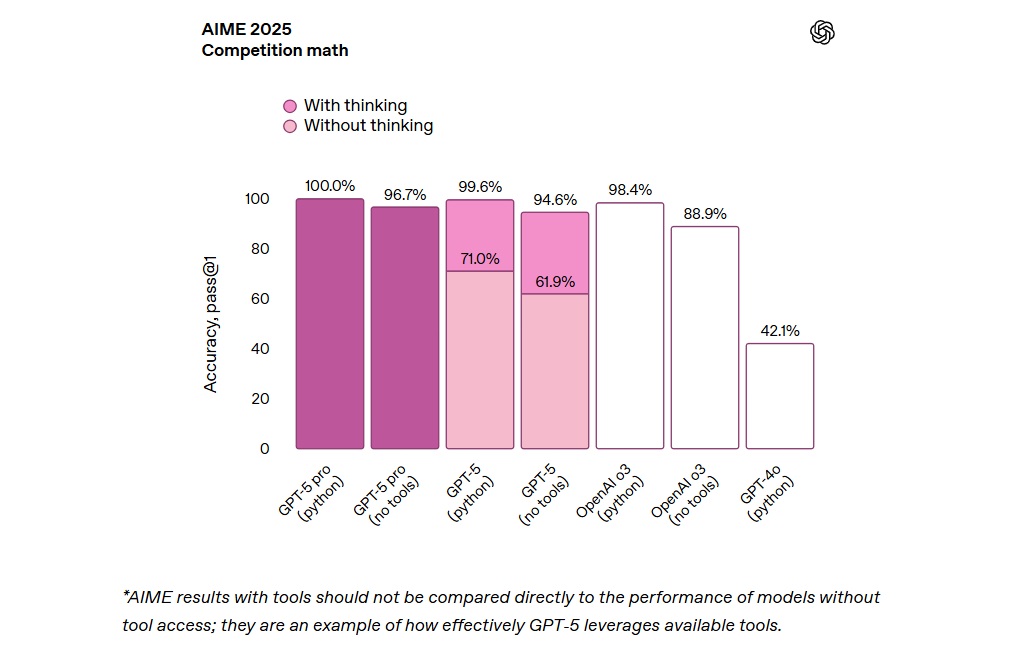
- 94.6% accuracy on AIME 2025 math competition (up from 42.1% with GPT-4o)
- 74.9% success rate on SWE-Bench coding challenges
- 46.2% performance on HealthBench Hard medical scenarios (compared to 31.6% for o3)

AI Integration and Development Impact
For Developers and Integrators
Enhanced API Capabilities:
- Support for raw text inputs without JSON wrappers
- Context-Free Grammar (CFG) support for structured outputs
- Improved responses API for maintaining reasoning across tool calls
Cost Efficiency:
- Aggressive pricing: $1.25/million input tokens, $10/million output tokens
- 90% discount on cached tokens for repeated interactions
- Automatic routing reduces computational costs by using appropriate model sizes
Technical Architecture Deep Dive: GPT-5
The Multi-Model System
Model Specialisation: Each model in the GPT-5 family serves specific purposes:
- GPT-5-main: Optimised for speed and general tasks
- GPT-5-thinking: Enhanced reasoning capabilities with longer processing time
- Mini/Nano variants: Resource-optimised for simpler queries or edge deployment
Context and Memory Management:
 Read alsoWhy Most Australian SMEs Use Only 20% of What They Are Paying For Zoho CRM
- 400,000 token context window (272,000 input, 128,000 output)
- Advanced memory consistency across multi-turn interactions
- Improved goal tracking and context maintenance
Safety and Reliability Improvements
Reduced Hallucinations:
- 26% lower hallucination rate for GPT-5-main compared to GPT-4o
- 65% fewer factual errors for GPT-5-thinking compared to o3
- Improved abstention capabilities – the system now more readily admits uncertainty
Enhanced Instruction Following:
- Better hierarchy enforcement (system > developer > user instructions)
- Reduced sycophantic behaviour (69-75% reduction in overly agreeable responses)
- Improved resistance to prompt injection and manipulation
Looking Forward: Implications for AI Development
The Shift to System Thinking
GPT-5 represents a crucial shift from “bigger models” to “smarter systems.” This approach suggests the future of AI development will focus on:
- Orchestration over raw power
- Efficiency over brute force
- Specialisation over generalisation
Integration Considerations
For businesses considering GPT-5 integration:
Immediate Benefits:
- Improved accuracy and reliability for customer-facing applications
- Better cost management through automatic model routing
- Enhanced tool integration capabilities
Strategic Considerations:
- Plan for ongoing model evolution rather than static implementations
- Design systems that can adapt to changing model behaviours
- Implement monitoring to ensure consistent performance
Conclusion
GPT-5 is not just another language model, it is a glimpse into the future of AI systems. By building upon every lesson learned from the GPT lineage, OpenAI has created something that is genuinely more than the sum of its parts. The auto-routing system, enhanced tool integration and improved reliability make it a compelling upgrade for serious AI applications.
However, the mixed public reception highlights an important consideration; technical improvements do not always translate directly to user satisfaction. The challenge for developers and integrators will be leveraging GPT-5’s enhanced capabilities while maintaining the user experience qualities that made earlier models beloved.
For businesses looking to integrate AI, GPT-5 offers a mature, reliable platform with unprecedented capabilities. The key is approaching integration thoughtfully, with proper planning and consideration for both technical capabilities and user experience needs.
Are you ready to try out GPT-5 family of models? Visit the official ChatGPT interface to get started with these models. Or you can also use the API directly in your application. Need a team to assist you with GPT-5? Our team at Fuzn can automate it for you. Get in touch with us today to get started.